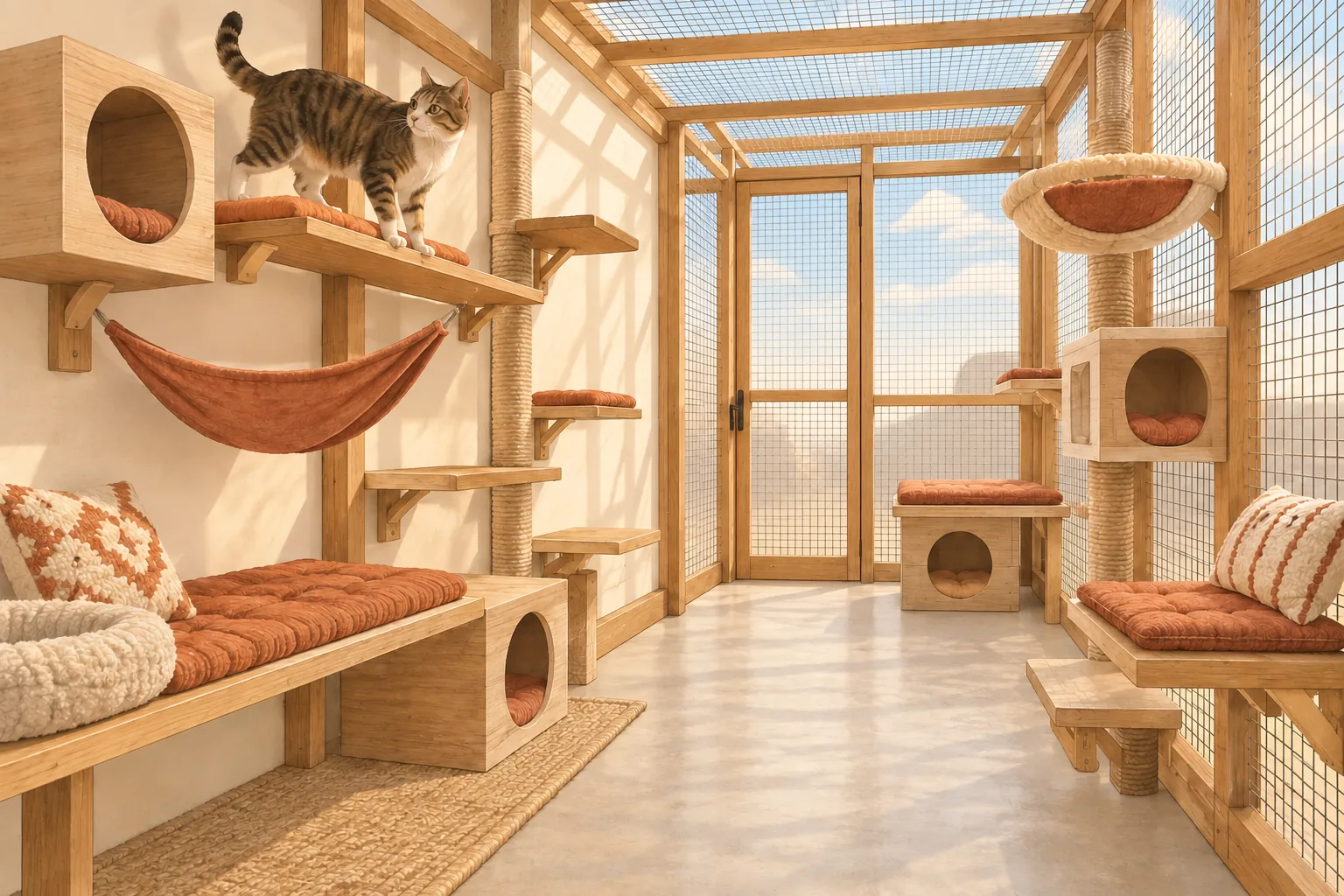
A catio interior can become crowded quickly. Perches, beds, planters, scratchers, toys, and décor may all seem useful in isolation, yet together they can make cleaning difficult and leave the cat with less room to move. Start with the route through the enclosure, then add a small number of features that have a clear purpose: rest, observation, scratching, movement, or easy return indoors.
Draw the clear zone first
Before choosing a perch or a bed, mark the human route for cleaning and inspection. Then mark the cat’s route from the entrance to a resting place and back again. Keep these paths simple. If furniture creates a tight maze, remove an item before adding another.
Leaving open floor space is not an unfinished design. It gives the cat room to turn, pause, and choose a direction. It also gives you a place to stand while you clean. In a compact enclosure, open space often does more work than a fourth decorative shelf.
Use a role-based layout
| Interior role | Useful question | Design cue |
|---|---|---|
| Observation | Where can the cat look out without blocking the entry? | One calm perch facing the view |
| Rest | Where can the cat settle away from the busiest edge? | A protected bed or platform with easy exit |
| Movement | Can the cat move between levels without a forced route? | Clear transitions and an uncrowded floor |
| Scratching | Can the surface be checked and cleaned easily? | A stable option away from the main doorway |
| Care | Can a person reach every area without rearranging the enclosure? | An intentional clear strip or access point |
Assigning each item a role keeps the interior from becoming a shopping list. If two objects do the same job, choose the one that is easier to clean, inspect, and remove when the season changes.
Place the first perch around the view and the exit
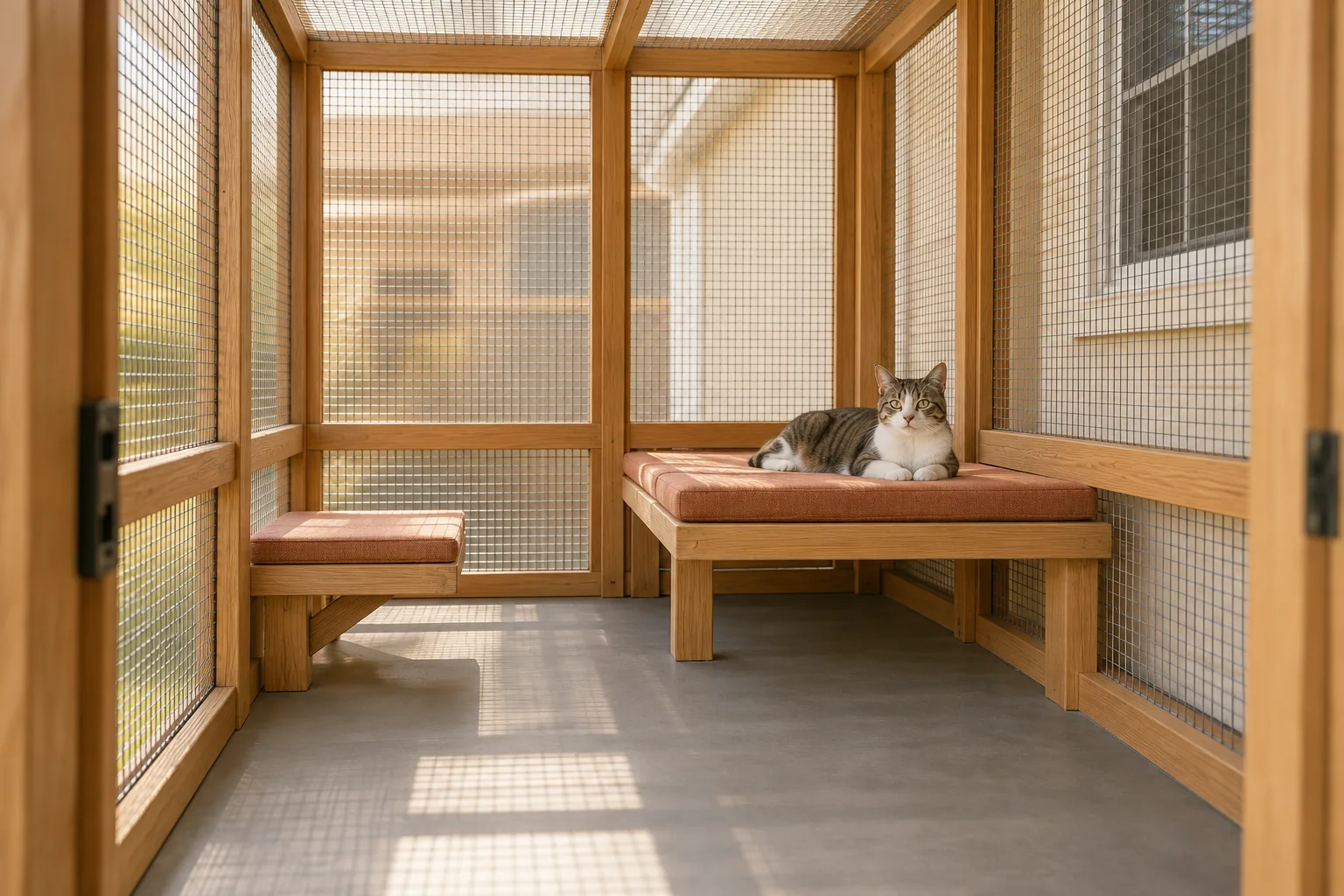
A perch can offer a lookout, but it should not block the cat’s only path or create a place where another pet can trap the cat. Keep the entrance visible from more than one point in the enclosure. Place resting features where the cat can leave them without having to cross a bottleneck.
The FelineVMA environmental-needs guidance emphasizes control and choice within the cat’s environment. In practical terms, that means giving the cat options rather than one dramatic destination. A low resting spot and an elevated observation spot can be more useful than a single tall feature that dominates the entire interior.
Make cleaning a visible part of the layout
Ask three questions while standing at the access point: Can I see the floor? Can I reach the corners? Can I remove or wash the textiles without dismantling the enclosure? If the answer to any question is no, simplify the layout. Use materials and furnishings according to their manufacturer care directions, and avoid adding objects that trap leaves, moisture, or hair in inaccessible gaps.
Do not store cleaning chemicals, loose tools, or small accessories in the cat’s space. Keep maintenance supplies outside the enclosure and use a routine that fits the household. An interior that is easy to reset is more likely to remain useful than one that requires a complicated seasonal overhaul.
Separate enrichment from clutter
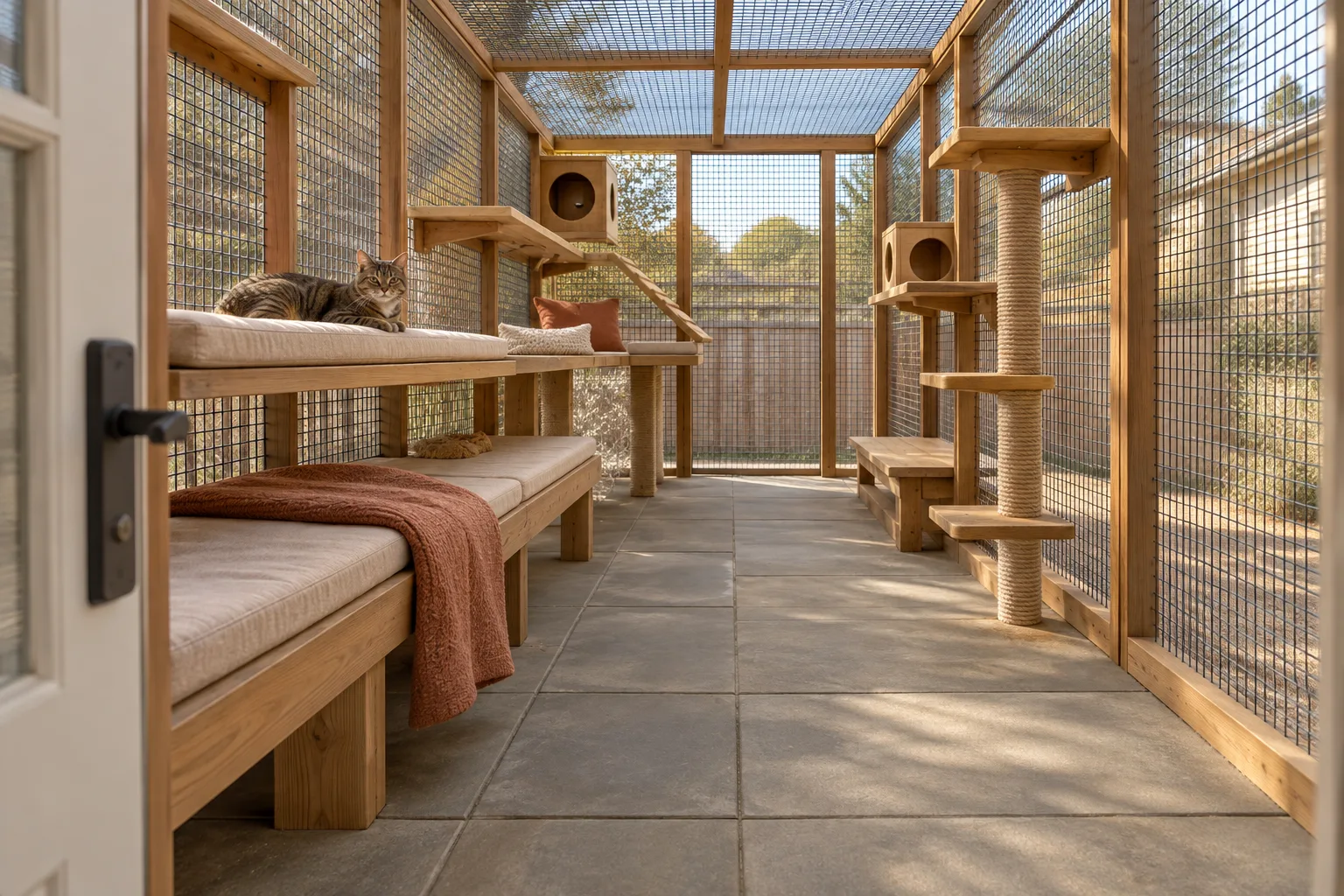
Enrichment does not mean a permanent pile of toys. Rotate a small number of appropriate items and observe what the cat uses. Keep interactive toys that require supervision out of the enclosure when no one is present.
FelineVMA notes that controlled outdoor access can offer a more stimulating environment. The design goal is therefore a space the cat can comfortably use, not a display that is full at all times. The enclosure should still feel calm when there are no toys or people in it.
Plan for weather and reset days
Before adding cushions, rugs, or decorative objects, decide where they go during cleaning, rain, repairs, or seasonal changes. Check the interior after wind, heavy weather, or periods when the cat has not used it.
If the cat suddenly avoids an enclosure that was previously familiar, do not assume the answer is another accessory. Check for changes in noise, smell, access, or weather exposure, and seek veterinary advice if the cat appears distressed or unwell. A layout can remove obstacles, but it cannot diagnose a health or behavior problem.
Interior layout checklist
- There is a clear, human-sized route for inspection and cleaning.
- The cat has an obvious route from the entrance to a resting spot and back.
- At least one feature supports observation and one supports quieter rest.
- Furniture does not block the entrance or create a single unavoidable bottleneck.
- Every textile, perch, and scratch surface has a practical cleaning plan.
- Loose items and supervised-play toys are not left out by default.
- The interior can be simplified if the cat does not use an item.
Keep the interior legible
A good catio interior is easy to read. You can see where the cat rests, where the cat moves, and how you will keep the space clean. Start with those three functions. Add only what improves one of them, and leave enough empty space for the enclosure to feel like a place rather than a display shelf.
That restraint also makes future changes easier. As you learn which perch, view, or resting spot the cat chooses, you can refine the interior without undoing a crowded first design.
If the tray shares a catio with perches and resting areas, pair that layout discussion with the litter-box access and cleaning worksheet before choosing where a person will scoop or remove it.