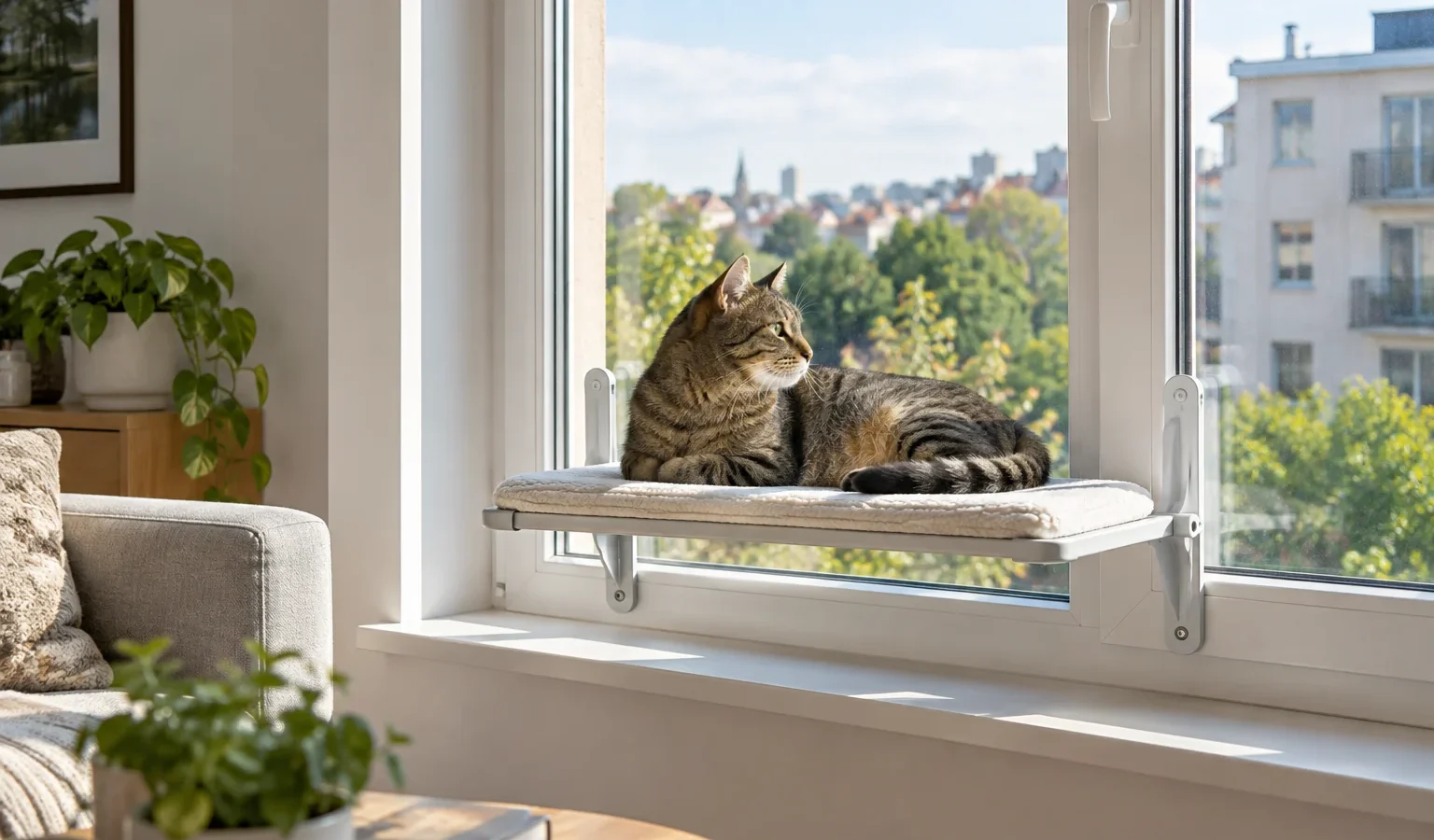
A cat window perch can turn an unused view into a calm resting place, but the word window does not make every perch suitable for every opening. The important questions come before style: Is the window itself secure? Does the mounting method match the exact surface? Can the full setup support the cat according to the manufacturer’s instructions? Is there a controlled route up and down? Can you inspect the attachment without guessing?
This guide is a pre-purchase screen, not a structural certification. Use the instructions for the exact product and window, follow any landlord or property rules, and stop when the manufacturer does not clearly approve the proposed surface or use.
A window perch is not window-fall protection
A perch gives a cat a place to rest. It does not secure an open window, strengthen a screen or prevent a fall. The ASPCA recommends secure, sturdy window screens to help prevent high-rise falls. Treat that as a separate safety decision from the perch itself.
Before considering any perch, close and latch the window as it will be used around the cat. Check the screen and frame independently. A screen that looks intact may still shift under pressure, and an insect screen should not be treated as a cat barrier unless its manufacturer explicitly says otherwise. If safe window use is unresolved, solve that first and leave the perch out of the plan.
Check 1: Identify the mount and the exact compatible surface
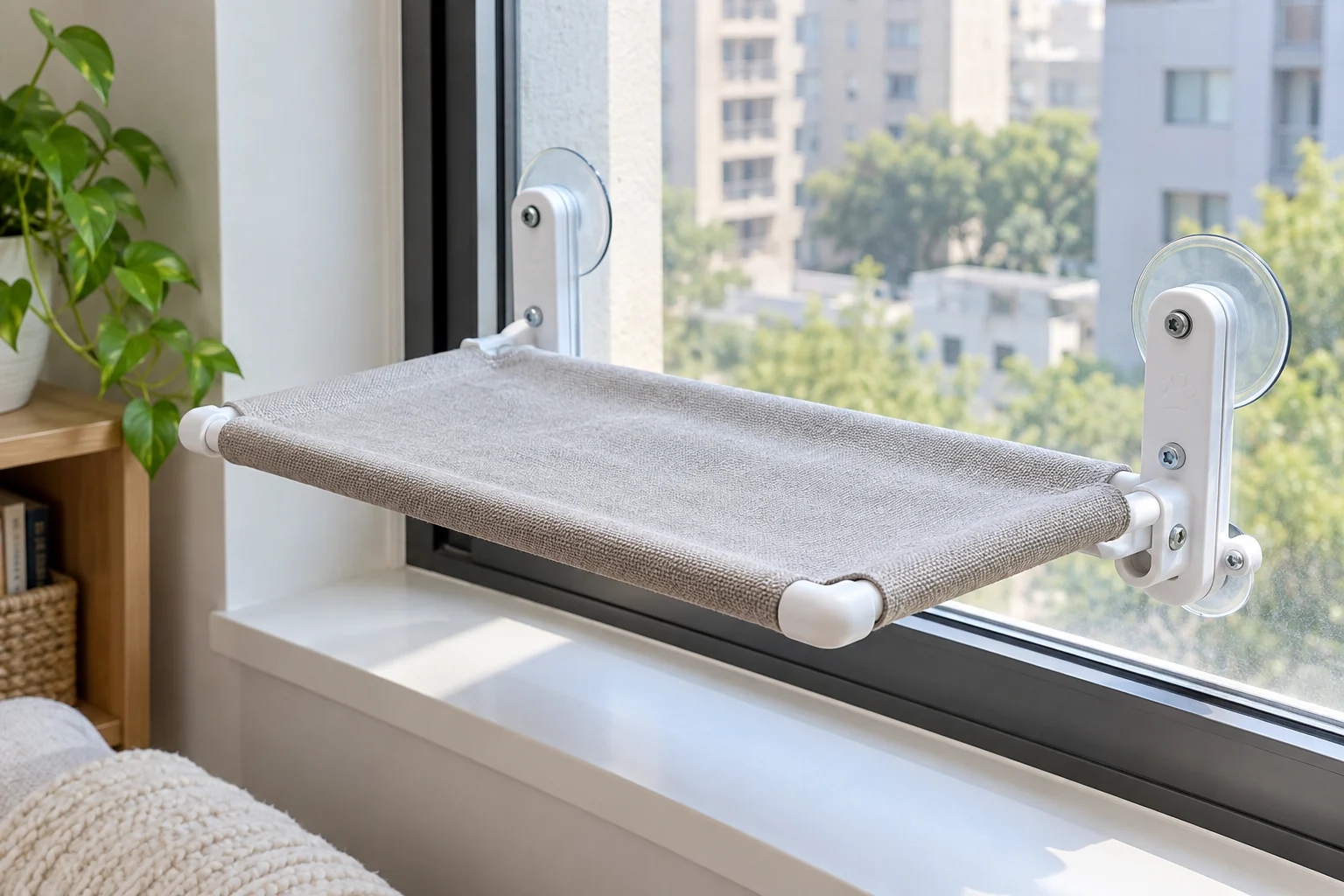
Window perches use different systems: suction cups on glass, brackets at a sill, hardware attached to a frame, or a freestanding structure placed near the view. These are not interchangeable. A product intended for clean, smooth glass does not automatically suit textured glass, film, trim or a moving sash. A sill-mounted design still needs the sill depth and edge shape specified by its maker.
Read the current manual before buying. Confirm the allowed surface, preparation steps, replacement parts and any restrictions. The PetSafe Cat Veranda manual, for example, shows why the exact assembly and attachment sequence belongs to the product documentation rather than a generic photograph. If the required surface cannot be identified confidently, choose a different mounting type.
| Mount type | Question to answer first | Reason to pause |
|---|---|---|
| Suction-mounted | Does the maker approve the exact glass surface and preparation method? | Film, texture, damage or unclear glass compatibility |
| Sill or frame-mounted | Do the measured depth, edge and clearance match the instructions? | The window cannot close, latch or move normally |
| Hardware-mounted | Is attachment permitted and is the substrate appropriate? | Unknown material, hidden services or rental restrictions |
| Freestanding | Is the base stable and the route clear? | Rocking, tipping or a crowded approach |
Check 2: Measure the real window, sill and clearance
Measure the usable area rather than estimating from the overall window. Note handles, locks, blinds, curtains, radiators, furniture edges and the movement of the sash. The perch should not stop the window from closing and latching, trap a cord, or force the cat through a narrow gap.
Then look beyond the mount. Can the cat turn around without pressing against glass or a blind? Can a person inspect the entire attachment? Can the cover be removed for cleaning without dismantling nearby furniture? Our small cat room guide uses the same principle: preserve a clear route before adding another object.
Check 3: Compare the total likely load with the product specification
Use the manufacturer’s published limit for the complete product and follow its installation conditions. Do not rely on a marketplace title, an unverified review or the cat’s resting weight alone. Movement adds a different demand from lying still, and two cats may use a platform even when it was purchased for one.
Consider the heaviest realistic use in the household: the cat, a second cat that may join, and any removable pad or accessory the instructions allow. If the maker does not publish a clear specification, if the model cannot be identified, or if the household use exceeds the stated conditions, do not improvise a higher limit. A broad freestanding platform or another approved resting option may be the better choice.
Check 4: Plan a calm way up and down
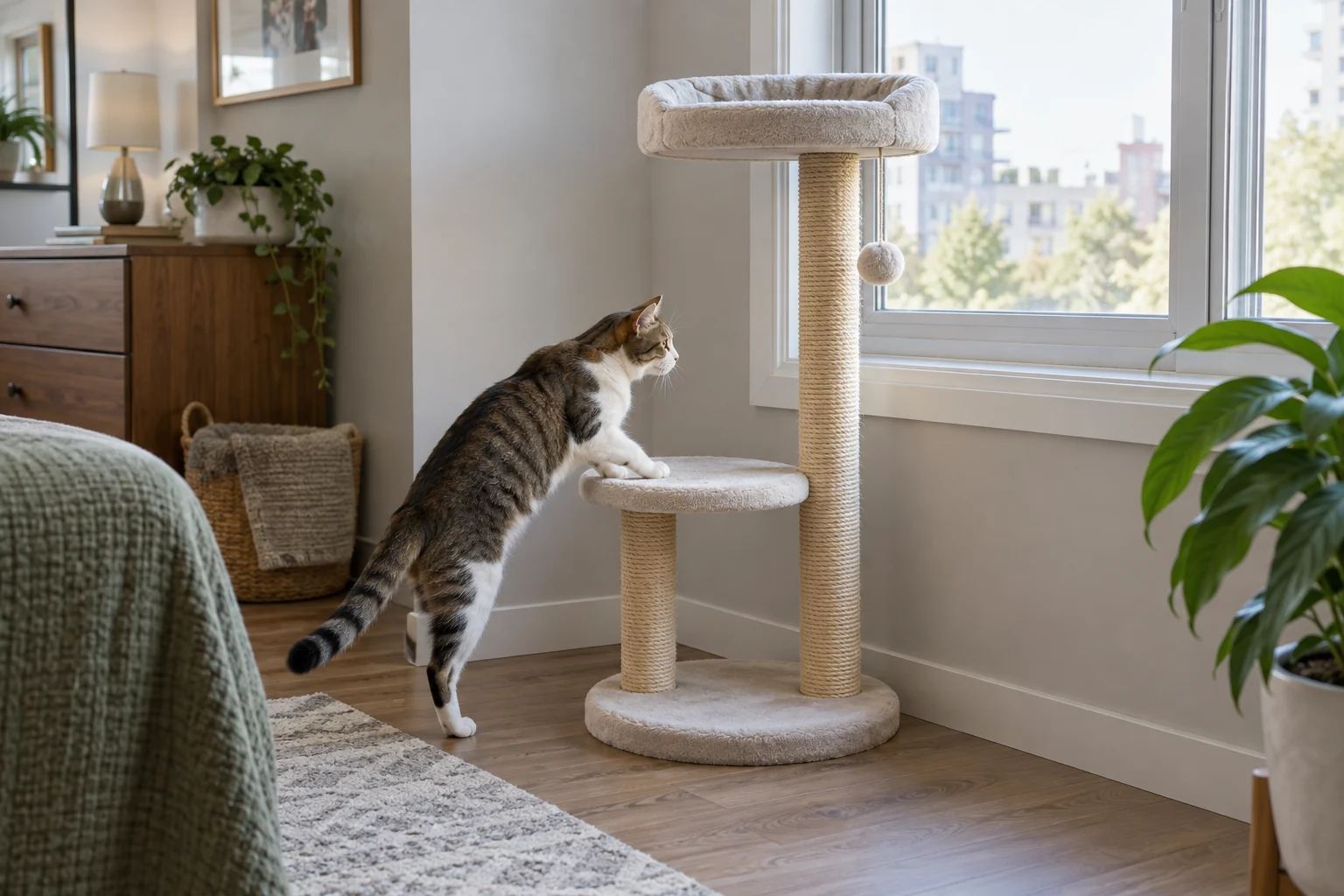
A secure platform is only one part of the route. Watch how the cat normally approaches elevated places. A landing that requires a sharp jump from a slippery surface, crosses a doorway or competes with another pet can make an otherwise suitable perch difficult to use.
FelineVMA guidance on the home environment includes safe places, elevated options and separated resources. Its environmental-needs guidance also emphasizes choice and control. In practice, provide a clear approach and more than one comfortable resting option rather than making one window seat the only desirable destination.
For a room-level view, use our cat room planning guide. If the cat already uses a wall route, compare the perch with the checks in our cat wall shelves pre-purchase checklist instead of assuming the two systems can share a landing.
Check 5: Create a maintenance and stop-use routine
Decide how often you will inspect the setup using the manufacturer’s instructions and the household’s actual use. Check every attachment point, strap, cable, bracket, fabric seam and removable cover. Clean only with methods compatible with the materials, and reinstall every part exactly as directed.
Stop use when the perch shifts, rocks, sags, develops damaged fabric or hardware, no longer fits the window in its normal closed position, or cannot be reassembled according to the manual. Also pause after a window replacement, new film, repainting, a moved bracket or any change to the mounting surface. Do not wait for a failure to confirm that a visible change mattered.
When a freestanding perch is the better answer
A freestanding perch beside a closed window may be simpler when mounting compatibility is uncertain, permanent attachment is not allowed, several windows are used seasonally, or cleaning access matters more than a floating look. It still needs a stable base, an uncluttered route and enough distance from cords, heaters and moving window parts.
This option does not remove the need for secure window screens and normal supervision. It simply separates the resting furniture from the window hardware, which can make each part easier to evaluate.
Before-you-buy checklist
- The window can close and latch normally, and screen safety has been considered separately.
- The exact mount is approved for the measured surface, sill or frame.
- The full likely household use fits the manufacturer’s stated conditions.
- The cat has a clear, noncompetitive way up and down.
- A person can see, clean and inspect every attachment point.
- Rental, property and installation restrictions are resolved.
- There is a clear stop-use plan for movement, wear or changes to the window.
Choose the setup you can verify
The strongest window-perch plan is not the one with the most dramatic view. It is the one whose window condition, mounting method, limits, route and maintenance steps can all be checked without assumption. If one of those answers stays vague, use a simpler approved option and keep the window itself secure.