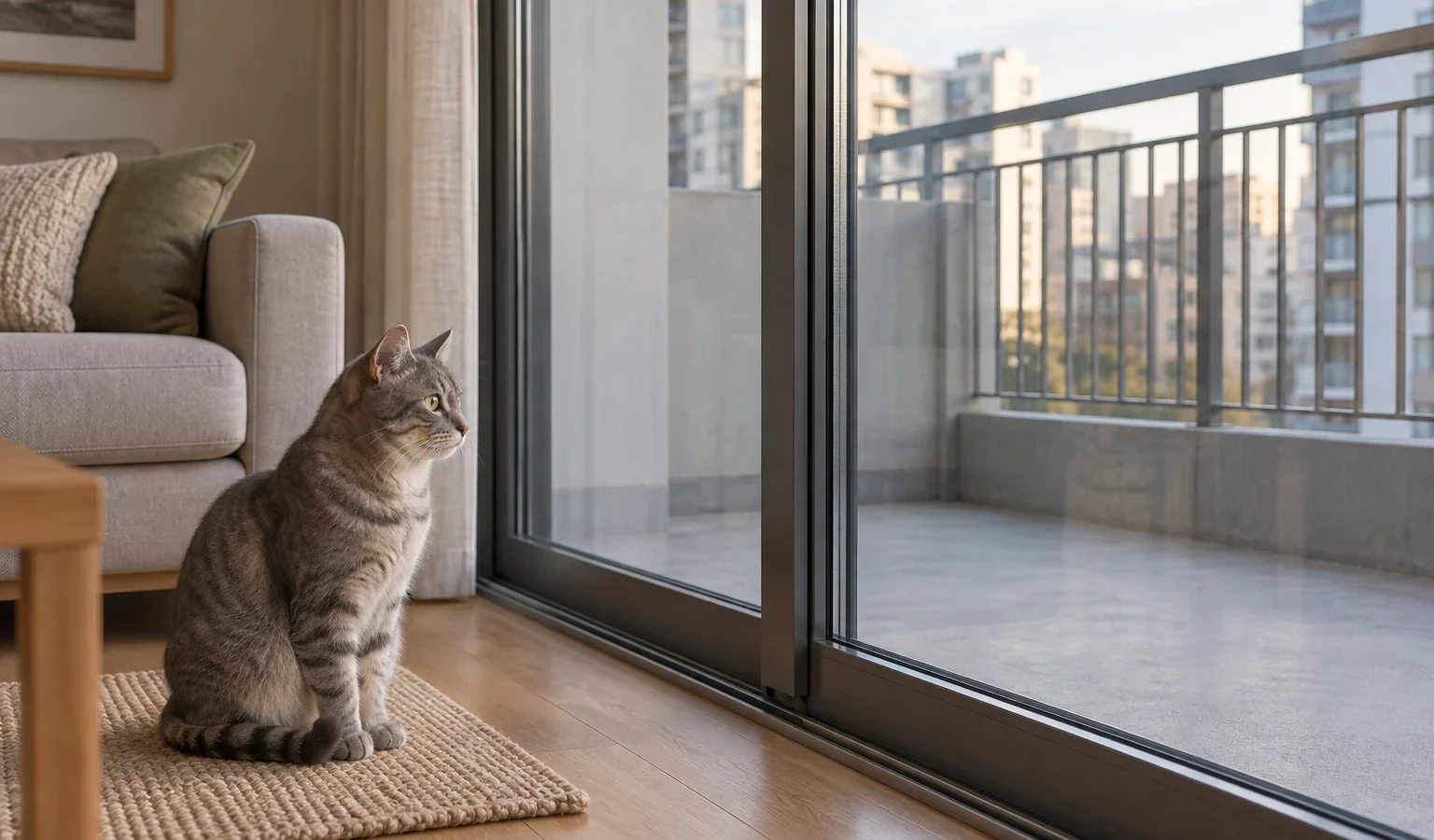
A balcony door creates a decision point, not an automatic cat area. For an apartment renter, permission from the building or landlord and the balcony’s physical suitability are separate questions. Record both before access, name who can resolve each unknown and keep the door closed while any answer is unresolved. This article is a planning worksheet, not legal, engineering or veterinary advice, and it does not certify a balcony or enclosure.
Cats Protection’s indoor-cat guidance recommends full ceiling-to-floor barriers designed for cats, attention to entanglement and gaps, removal of hazards, an easy route back indoors and supervision at all times. It also advises restricting access when escape or frustration is a concern. Treat those as source-backed planning boundaries; the room-specific questions below are editorial prompts to help you investigate your own home.
Keep permission and physical review separate
Write the building question before looking at products. Ask the landlord or property manager whether balcony use by a cat is permitted, whether an enclosure, net, panel, fastener or furniture change needs written consent, and whether a contractor must be approved. Ask where the decision is recorded and who should be contacted if the lease, building rules and maintenance instructions differ. Do not infer permission from an empty balcony or from a neighbour’s arrangement.
Then create a separate physical-review question for the responsible person: who can inspect the actual balcony, door, frame, parapet, ceiling, drainage, weather exposure and any existing barrier? A permission answer does not prove the structure can accept a proposed attachment. A physical opinion does not grant permission. Keep those records separate so “allowed to investigate” does not become “approved to install.”
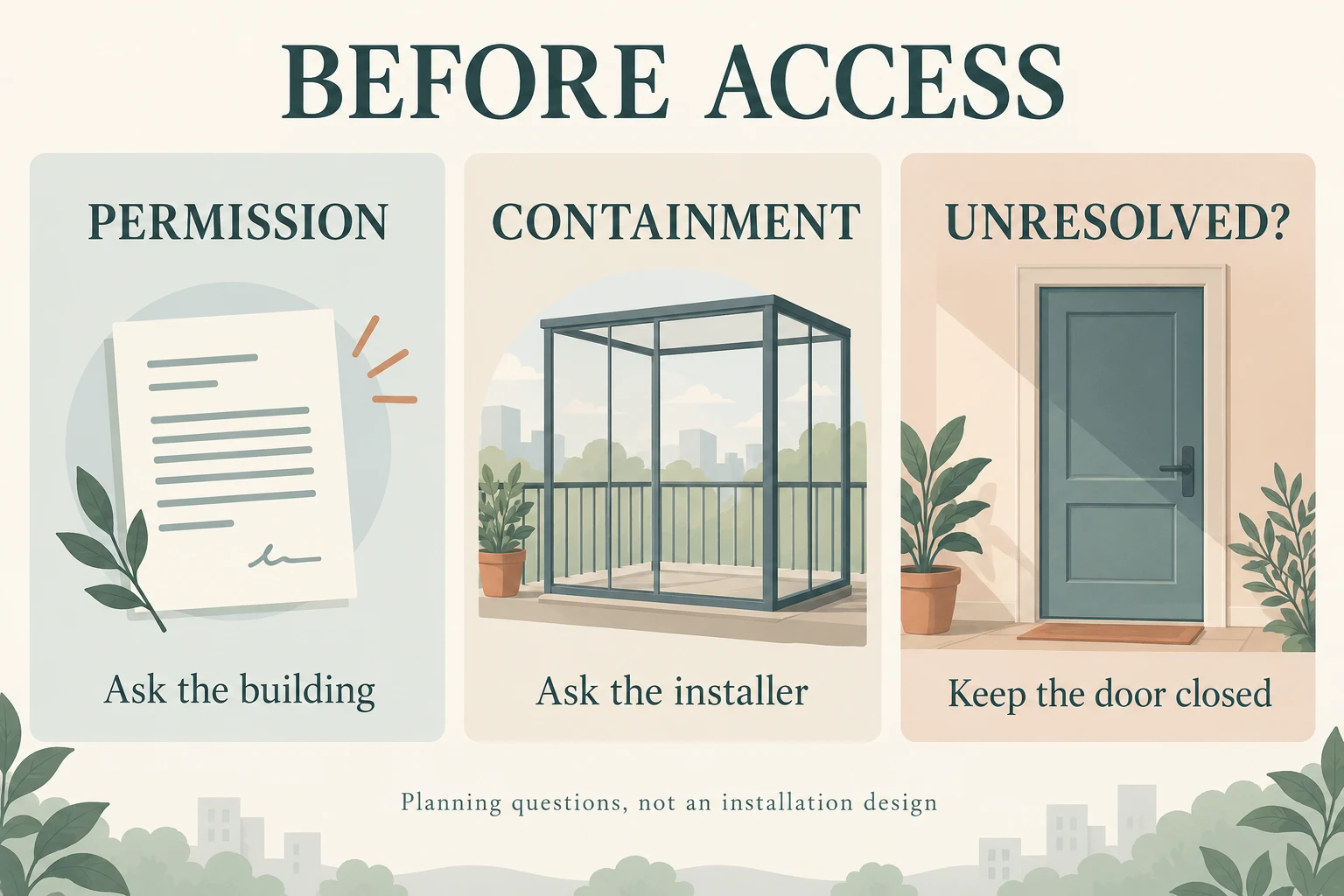
| Check | Record | Who resolves it? | Unresolved action |
|---|---|---|---|
| Building or landlord permission | Rule, contact, written answer and date: ___ | ___ | Keep balcony door closed |
| Physical suitability | Inspection questions and observed condition: ___ | Qualified installer or property contact: ___ | Keep balcony door closed |
| Door and return route | How the cat returns indoors every time: ___ | Household adult: ___ | No access until rehearsed |
| Supervision plan | Who watches and for how long: ___ | Named adult: ___ | No access without that person |
| Indoor alternative | Window, perch or room activity available: ___ | Household: ___ | Use indoor option |
Inspect questions without inventing dimensions
Look at the balcony as it exists, with the door closed and the cat elsewhere. Note openings, corners, sharp or snag-prone items, loose materials, drainage paths, weather exposure and anything that could become a launch point. Do not turn these observations into a universal gap measurement or a promise that a particular floor, railing or screen is suitable. Ask the responsible installer what must be verified for this exact building and what maintenance checks follow.
The ASPCA’s high-rise-syndrome guidance describes accidental falls after distractions around windows, terraces and other elevated areas, including one- and two-story buildings. It recommends well-fitting, sturdy window screens and warns that childproof window guards do not protect cats. Those window recommendations do not certify a balcony or replace a cat-specific physical review.
Remove hazards you can identify, but do not improvise a structure, attach hardware or assign a safety rating from a photograph. If a proposed change requires drilling, adhesive, tension, panels, netting or a load judgment, put that question to the landlord and a qualified installer. The answer belongs in the record for this balcony.
Write the door-opening routine
Separate ordinary human balcony use from cat access. For watering or cleaning, keep the cat inside a separate closed room while the balcony door is open. That containment routine does not grant permission for cat access. Before any cat access, all permission and physical-review questions must be resolved, a written return-indoors plan must be ready and a responsible adult must supervise. There is still no safety guarantee, even when an enclosure has been approved or installed.
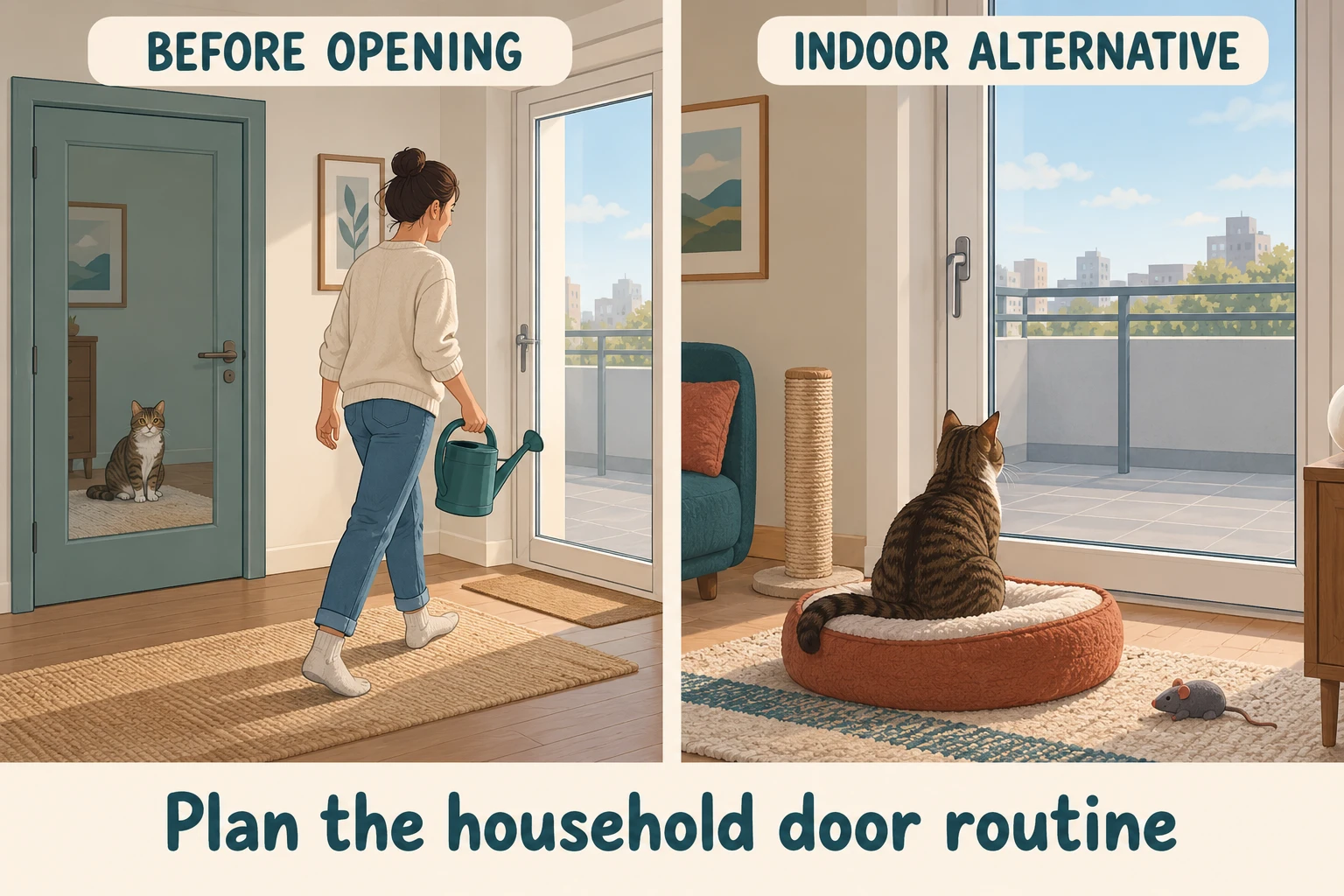
- For a human balcony task: put the cat in the separate closed indoor room before opening the balcony door.
- Before any cat access: confirm permission and physical review are resolved, the supervisor is present and the written return-indoors plan is ready.
- During access: remain present and watch the cat and the boundary; do not treat a phone call, cooking task or quick errand as supervision.
- Return indoors: bring the cat inside before the supervisor leaves, then close the door and confirm the cat is indoors.
- After closing: note damage, weather changes, moved objects or a new escape concern before the next decision.
If a household member cannot follow the routine every time, keep the balcony door closed. “I usually remember” is not a completed control. Put the routine near the door, explain it to visitors and include the no-access state in a sitter handoff.
Keep an indoor alternative ready
A cat can have a useful day without balcony access. Choose an indoor alternative that fits the actual apartment: a safe window observation place, a clear resting surface, a play session, scent exploration or another room-based activity. The alternative is not a substitute enclosure and does not prove the balcony is unnecessary; it gives the household a workable option while permission, inspection or supervision is pending.
Use the window perch safety checklist to review an indoor observation spot. For the broader room, use the cat room planner. The catio layout guide and buildable-project guide can help frame questions about a future structure, while the houseplant checklist covers a separate small-apartment access decision.
Recheck after every change
Repeat the record after a move, new lease, landlord instruction, repair, weather event, furniture change, new pet, visitor routine or alteration to the door. A previous approval does not answer a new physical question. If the permission record is missing, the boundary has changed, the return route is blocked or the supervisor is unavailable, return to the same stop state: keep the door closed and use the indoor alternative.
Use the window-treatment check alongside the renter permission record when a window, balcony door or curtain route changes the household access plan.
Sources and scope
- Cats Protection: Indoor cats — full cat-designed barriers, hazard and gap awareness, easy indoor return and continuous supervision.
- ASPCA: High-Rise Syndrome — fall risks around elevated openings, sturdy-screen recommendations and the warning about childproof window guards.
The permission questions, responsibility worksheet, door routine and indoor alternative are original editorial planning aids. Images are AI-generated illustrative concepts, not inspected installations, legal documents, engineering evaluations or safety guarantees.