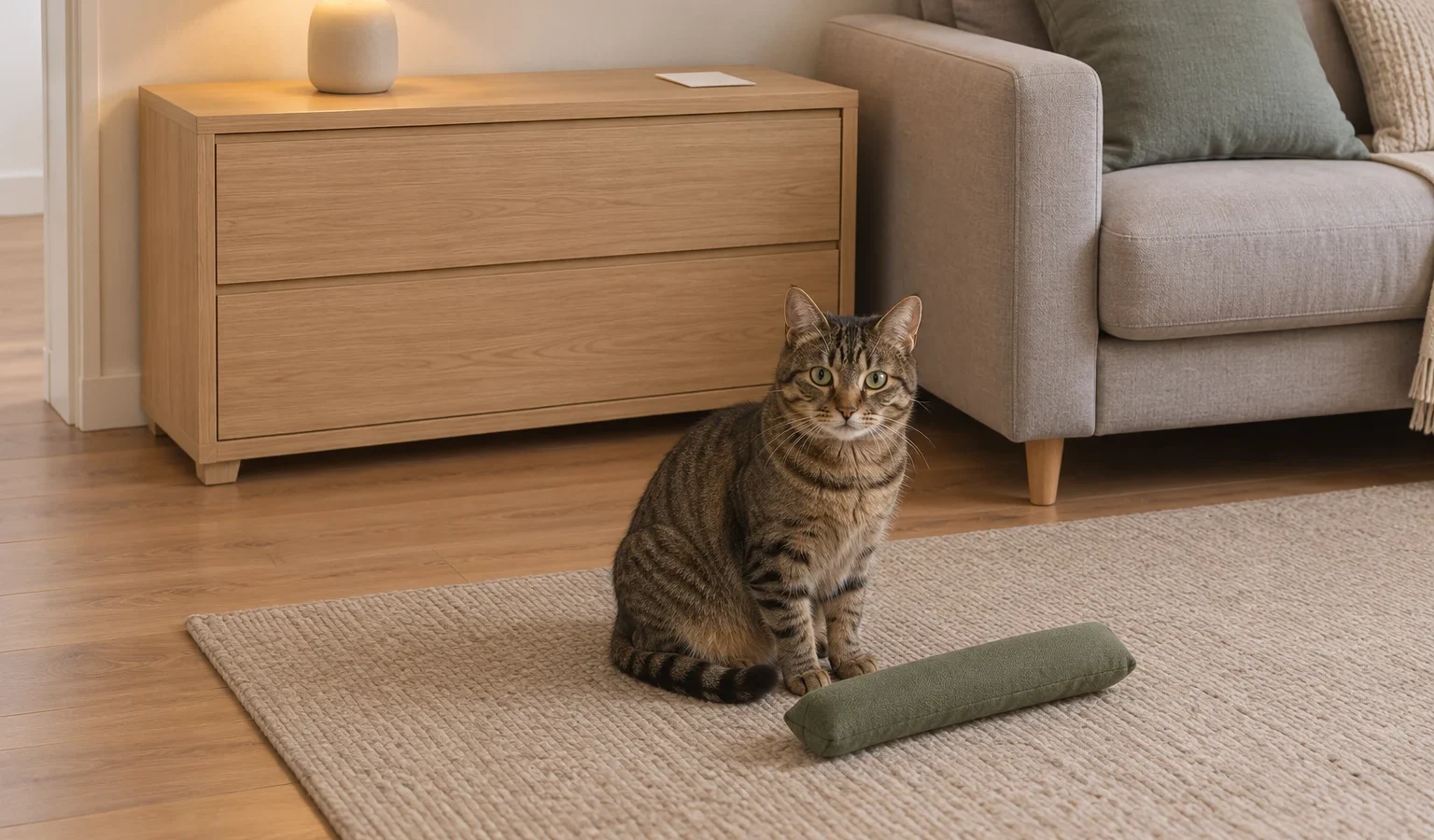
If a toy basket would occupy the only clear strip of floor in your apartment, start with the drawer or cupboard you already have. The aim is to give each toy a recorded home and a return decision, so stored toys remain findable without adding another piece of furniture.
This is a household organization guide. It does not certify a toy, diagnose behavior or determine how much play a particular cat needs. Toy choice, access, supervision and care must follow the product instructions and your cat’s individual needs.
Start with the toys, not a new container
Collect the toys you own and identify their instructions before deciding how to store them. Make three practical lists: items available for an appropriate play session, items awaiting care or inspection, and items you will remove from use. A toy with unclear instructions or questionable condition should not become a ready item merely because a storage compartment has space.
FelineVMA’s play guidance warns about swallowable string-type materials and loose parts. A closed storage location is a way to control access; it does not turn an unsuitable item into a suitable toy. Do not put string, ribbon, household elastic bands or other improvised items into the rotation just to fill a category.
For the surrounding space, use our shared-room planning guide. Storage should support the room you live in rather than take over the play area.
The drawer fit check
Use this original planning check with the drawer empty and the cat away from it. Measure usable internal width, depth and height, including the space lost to rails, hinges or an uneven base. These are your cabinet’s measurements, not universal recommendations.
| Check | What to record | When the drawer is a poor candidate |
|---|---|---|
| Closure | Can it close normally with the planned contents and any insert lids in place? | You must press down on toys, pinch parts or force the drawer. |
| Access control | Does it stay closed and prevent the cat reaching its contents? | The cat can open it, reach through a gap or pull out stored pieces. |
| Longest item | Where will it lie without bending against instructions or protruding? | It fits only diagonally over everything else or prevents closure. |
| Retrieval | Can you select one item without emptying the whole drawer? | The planned layers hide items or mix different care states. |
| Care space | Where will an item awaiting care stay separately contained? | The same unsorted pile receives clean, damp and questionable toys. |
Do not remove structural parts, alter runners or overload furniture to gain space. Follow the cabinet manufacturer’s loading and stability guidance. If this drawer cannot control access, choose other existing closed storage that can; height alone is not proof that a cat cannot reach it.
Give each toy a home and a status
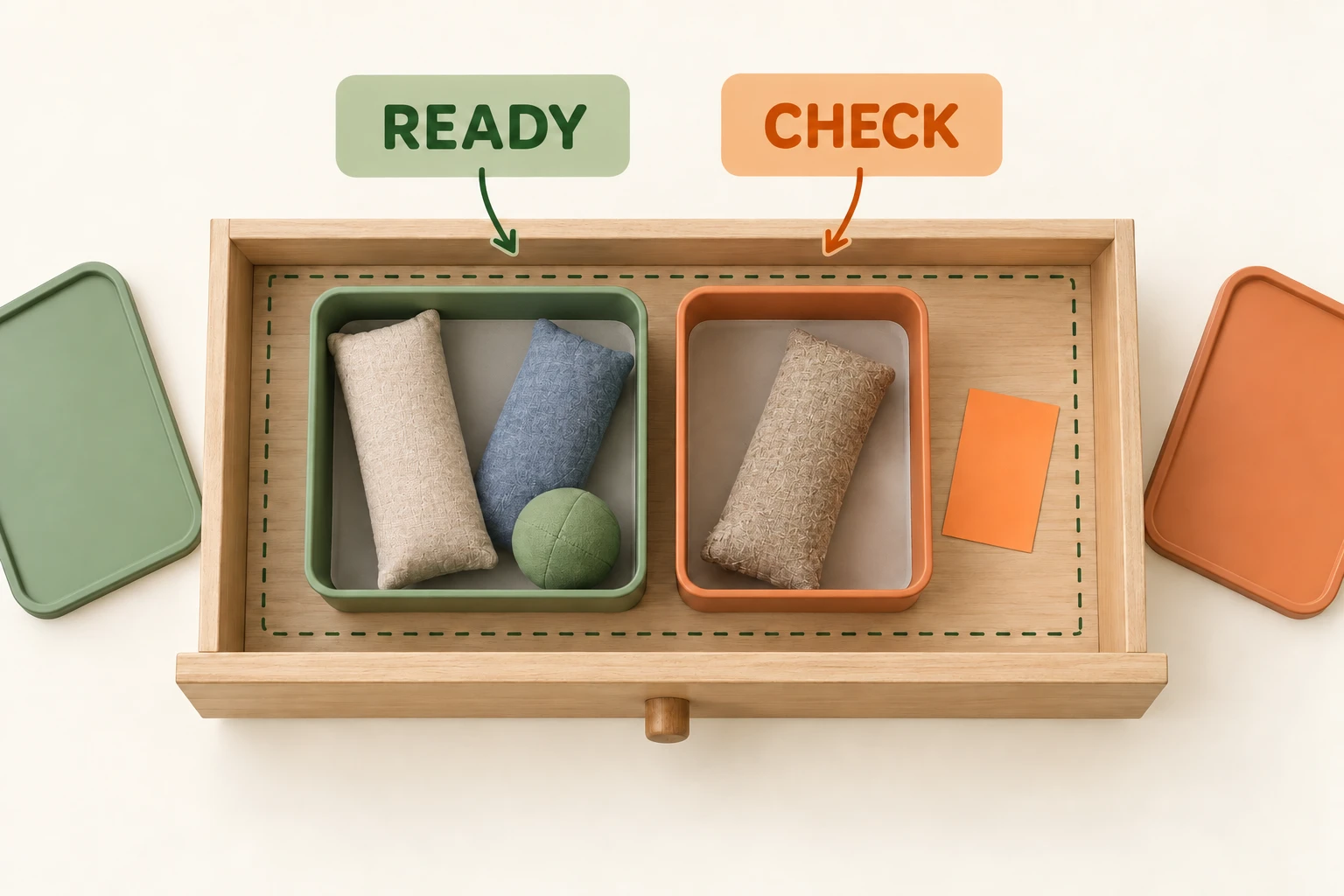
A single drawer does not need to hold every item. Use removable dividers or containers that fit the cabinet without snagging or defeating closure. Keep a ready area separate from a clearly identified check area. If separate containment does not fit, locate the check area in another existing closed space and record that location.
Long items that do not fit belong elsewhere; do not leave their attachments hanging out of the drawer. Food, treats, medicines and cleaning products have their own storage requirements and do not belong in this toy inventory.
The label ready means you have completed the appropriate condition and instruction checks for the intended use. It never means safe for every cat or safe without supervision. A check label is a hold status, not a repair recommendation.
Copy this toy inventory card
Keep a paper copy beside the closed storage or use a note on your phone. The useful unit is one identifiable toy, rather than an unlabelled bag described as “extras.”
| Field | What to enter |
|---|---|
| Item ID / description | Your own short ID and enough detail to recognize the toy |
| Instructions | Where the manufacturer’s use and care guidance is saved |
| Use and supervision | The conditions required for this particular item |
| Storage home | Exact drawer, section or other closed location |
| Current state | Ready for the intended use / awaiting care or check / removed |
| Next action | Specific care step, inspection or removal; follow the instructions |
| Last used / returned | A simple note to distinguish the active item from a parked one |
Illustrative record, not a tested recommendation: “T1 — plain fabric kicker; instructions saved with receipt; supervised session; living-room drawer, left insert; awaiting care; follow the washing and drying instructions before checking and returning.” Another item can remain ready in the same drawer’s separate area. The record prevents T1 from being pulled out as if nothing changed.
Use a return decision after play
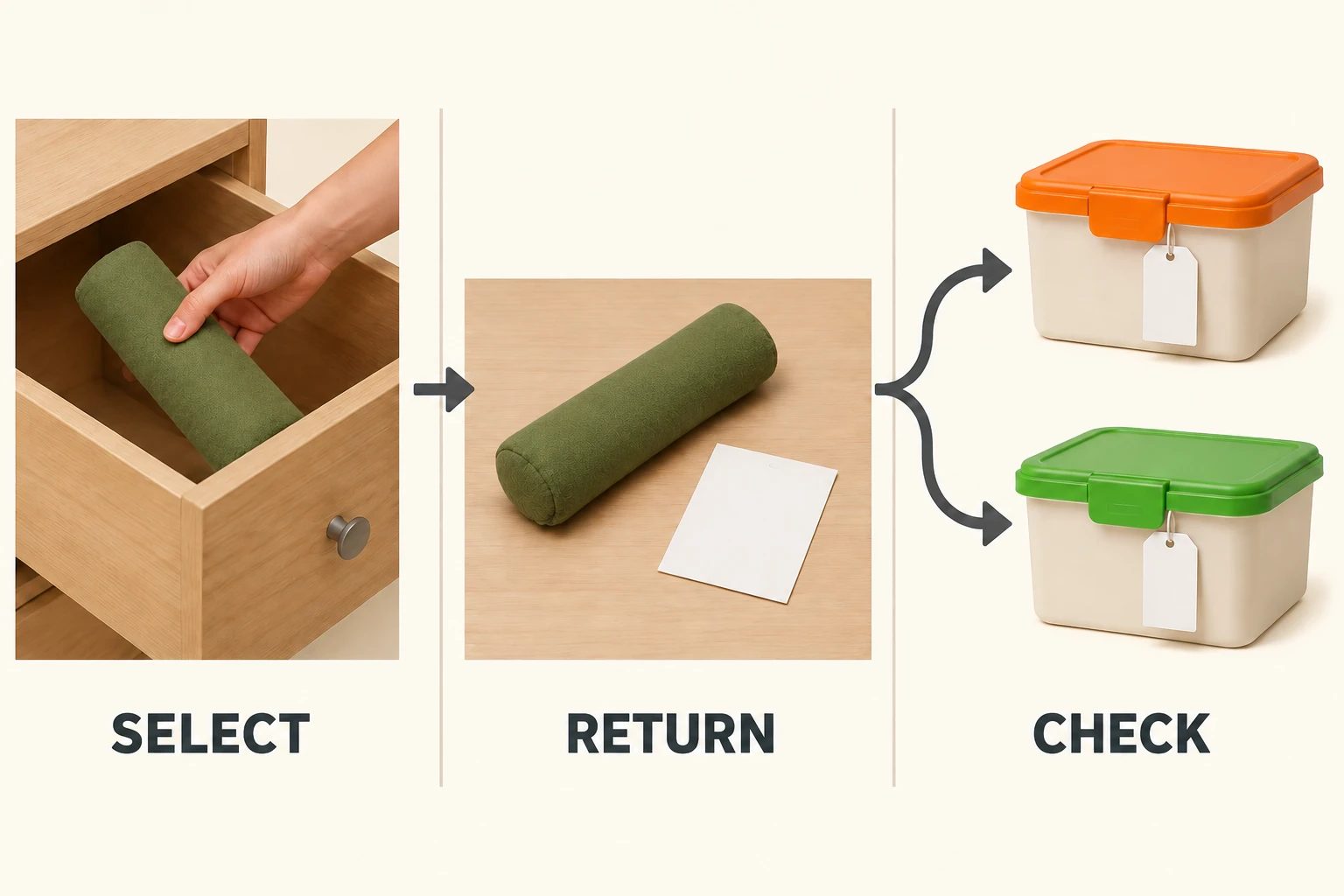
- Select: choose an item suited to the planned use and check its condition before the session. Close storage after retrieval.
- Return: locate the used item and review it against its care and use instructions. Do not put a damp toy straight into closed ready storage.
- Decide: return an appropriate, checked item to its named home; put an item needing attention in the check area and update its next action; remove damaged or unsuitable items from use.
- Close: check that no part protrudes and that the chosen storage still controls access.
This workflow is an organization aid, not a safety inspection standard. A quick look does not prove that a toy is safe. If you suspect a cat swallowed a toy part or is unwell, contact a veterinarian promptly rather than attempting to solve the problem through storage.
Rotate from the record, not a fixed shopping quota
The FelineVMA environmental-needs guide includes toy rotation among ways to support play. Use your record to find an appropriate parked item when you choose to vary a session. Keep the same condition, supervision and care checks when a familiar toy returns.
There is no required toy count or rotation interval in this drawer plan. An item being unused does not automatically mean you need a replacement purchase. First check whether it is findable, suitable for the intended session and in usable condition. Discuss a persistent change in your cat’s play or behavior with your veterinarian.
When the drawer gets full
Review the inventory before buying another bin. Remove items already marked for removal, finish outstanding care tasks and confirm that the remaining collection fits with the drawer closing normally. If it still does not fit, record a second existing closed location rather than forcing everything into the first.
Keep toys and storage clear of the cat’s separate resting space. Our hideaway placement guide covers that retreat, while the free room planner and room-planning overview help map the wider apartment.
If the household uses a shared drawer system, add the cat food storage worksheet beside the rotation record so another person can find the bag or label details.
Sources and further reading
- FelineVMA: Playing With Your Cat — play guidance and cautions about swallowable materials and loose parts.
- FelineVMA and iCatCare: Your Cat’s Environmental Needs — play opportunities and toy rotation.
The drawer fit check, inventory card and worked record are original editorial planning aids. Images are AI-generated illustrative concepts. We have not tested the pictured toys, drawer or storage arrangement.