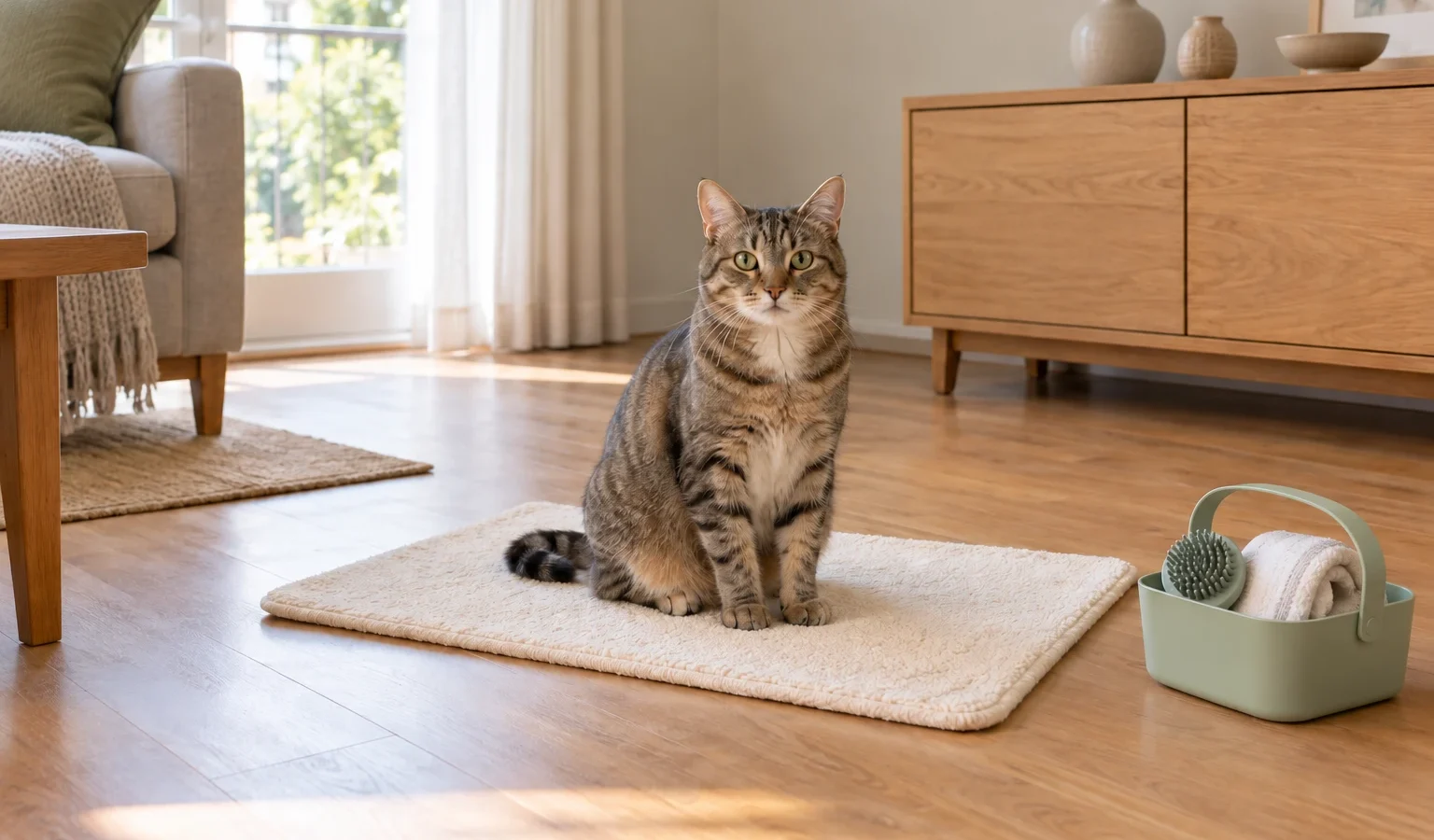
A cat grooming station in a small apartment can be a kit you take out and put away, rather than another permanent piece of furniture. Start with a suitable washable floor surface, the coat-care tool you already use under appropriate guidance, and a named storage place. Plan where used items wait for care as carefully as where clean items belong.
This guide helps you arrange the space and supplies for ordinary coat care. It does not teach bathing, clipping, nail trimming, restraint or mat removal, and the layout does not guarantee that a cat will accept grooming. If you need technique or tool advice, ask your veterinarian or a qualified cat groomer.
Draw the room in two states
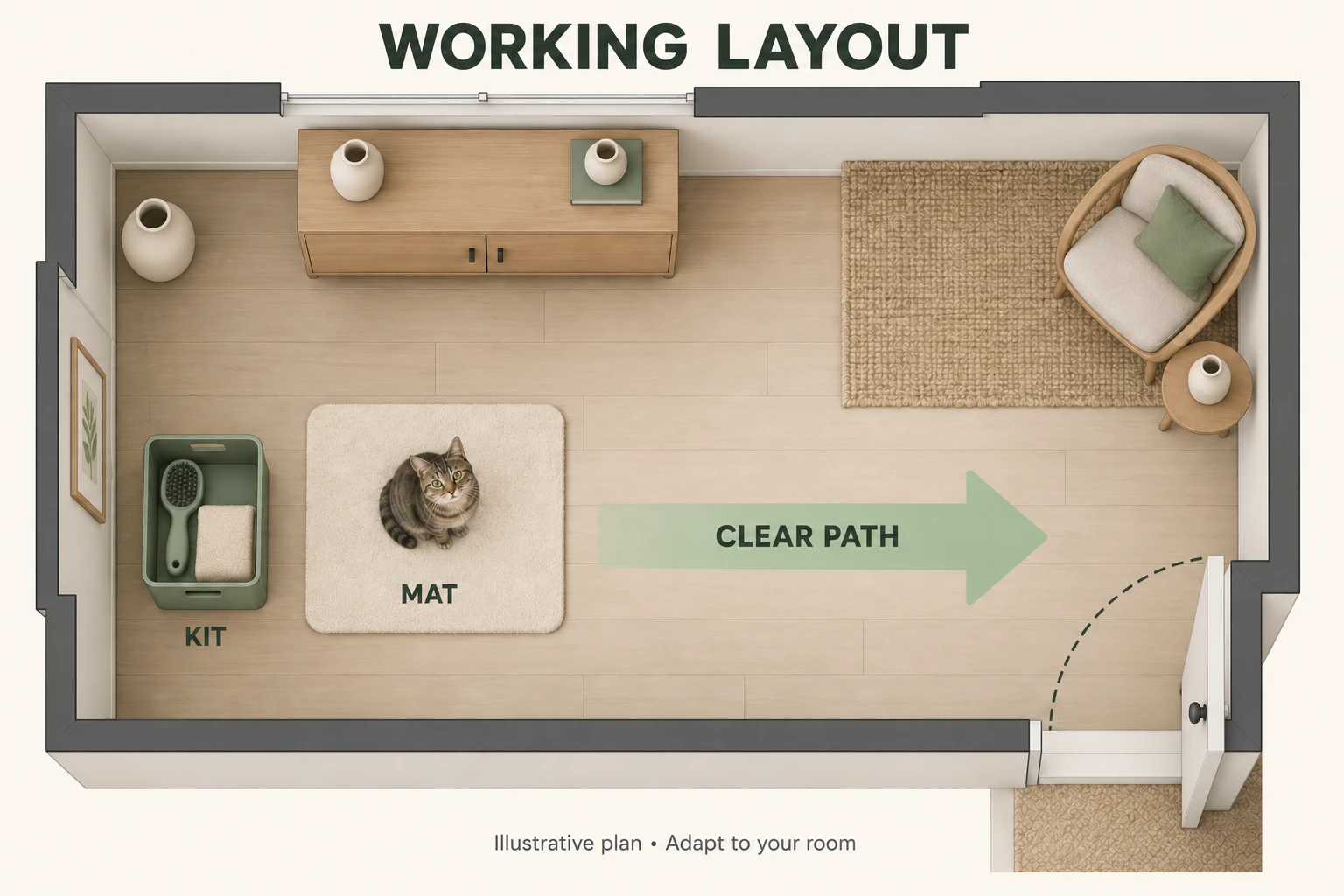
Make two small sketches: in use and put away. In the first, show the mat, your sitting position, the kit and an open route into the room. In the second, show where the folded or rolled mat and dry kit actually fit. A plan is unfinished if its supplies live in a doorway once the session ends.
Use our cat room planner for the surrounding layout. The working area must preserve access to doors, existing cat resources and ordinary household movement. There is no universal mat size or required clearance in this plan: use the dimensions of your room, supplies and the space you need.
Compare two locations before adding furniture
Pick two plausible floor-level spots in an existing room. Compare them while the cat is elsewhere; arranging supplies is not a reason to interrupt a resting cat. Open the relevant doors, move the chair as you normally would, and put the empty kit and mat in their proposed positions.
| Question | Candidate A | Candidate B | Reject the location if… |
|---|---|---|---|
| Where can I sit and place the kit? | Write the actual floor spot | Write the actual floor spot | You need an improvised raised surface or a crowded edge |
| Where can the cat move away? | Draw the open route | Draw the open route | The kit, your position or a door closes the route |
| What changes when someone uses the room? | Door, chair and walking movements | Door, chair and walking movements | Normal use pushes the kit into the mat or walkway |
| Where does the dry kit go afterward? | Name the cabinet or shelf position | Name the cabinet or shelf position | Storage cannot close normally or you must move unrelated stacks |
| Where do used items wait for care? | Name the laundry or tool-care spot | Name the laundry or tool-care spot | The only option is mixing them back with ready items |
Illustrative comparison: a space beside the sofa may look tidy but fail because a desk chair crosses the mat. Another spot beside an existing cabinet may work better if the room route remains open and the kit fits its own storage slot. This is a decision example, not a tested room or a claim that a sofa or cabinet location suits every cat.
For rooms shared with people, start with the movement checks in our small cat room guide. Do not turn a familiar hiding spot into the grooming supply area or block access to it; our hideaway placement guide covers that separate purpose.
Build a coat-care kit, rather than a miniature salon
Begin with the tool appropriate to your cat’s coat and the routine you have been shown, a clean washable surface, and a way to collect loose hair from the surroundings. Tool choice and use are individual; the illustrated brushes are generic objects, not product recommendations.
Keep coat-care supplies distinct from litter tools and food utensils. Store sharp tools, medicines, medicated products and cleaning products in their appropriate secure locations under their instructions, rather than adding them to an open everyday caddy. A handled organizer is storage, not a grooming surface or restraint device.
The FelineVMA’s home grooming guidance favors frequent short sessions and advises veterinary guidance when grooming changes or problems appear. Let the layout support an appropriate routine; do not keep a cat in place to finish a checklist. Stop if the cat resists or seems uncomfortable and seek guidance for persistent difficulty.
Give every item a return destination
Copy this card into a note or print the table. The point is to name the next place and action, especially when something cannot go straight back into the kit.
| Item | Ready-storage home | After use | Care instruction to keep |
|---|---|---|---|
| Coat-care brush or comb | Exact compartment in the dry kit | Separate tool-care tray until its required care is complete | Manufacturer’s cleaning, drying and inspection directions |
| Mat or towel | Exact folded or rolled storage slot | Named laundry or care location when needed | Fabric care label |
| Hair-collection item | Named cleanup-supply location | Empty or care for it as its instructions require | Product care and disposal directions |
| Kit container | Named cabinet or shelf slot | Check for debris and follow its care directions | Container care instructions |
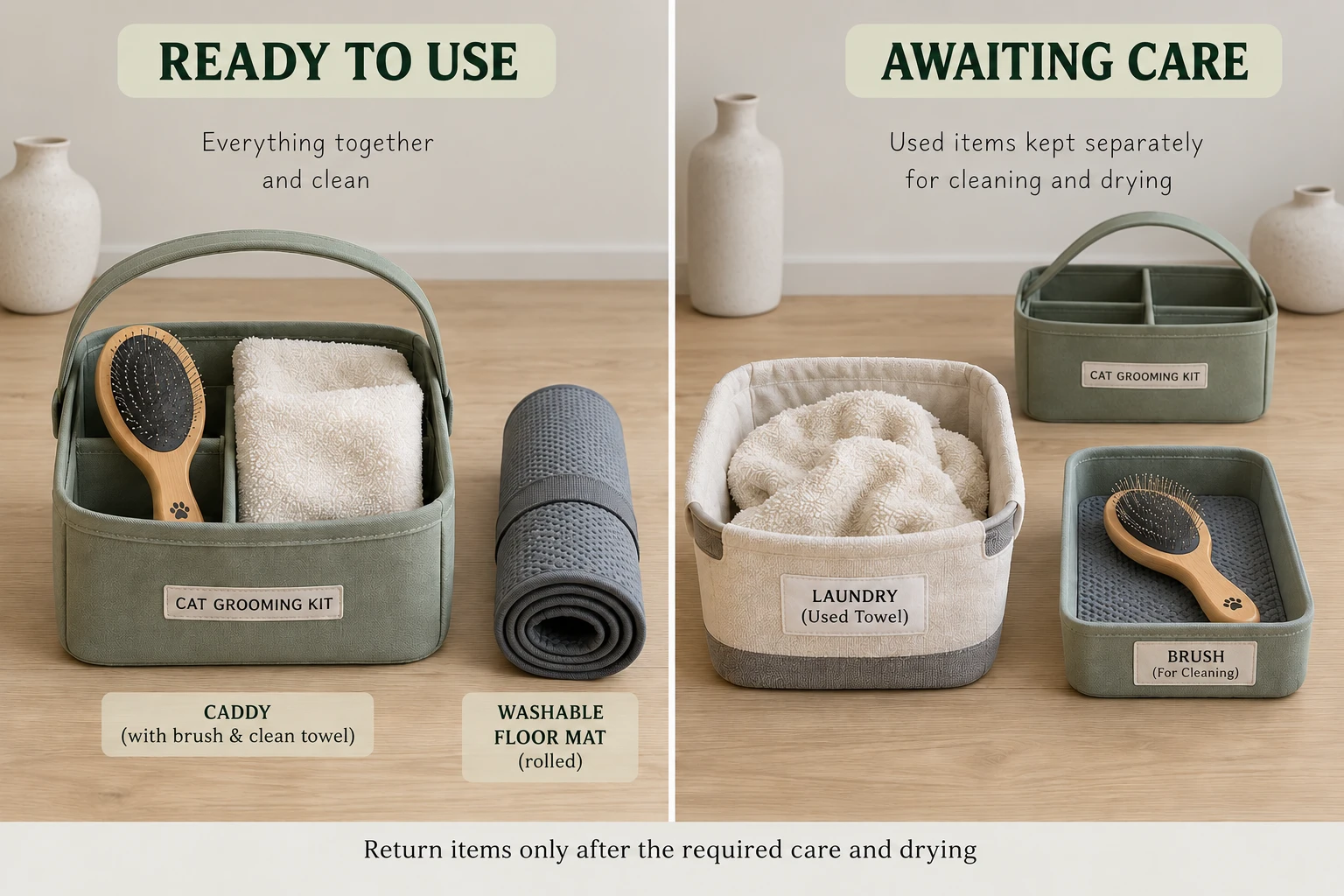
Do not read “ready” as disinfected or suitable for every cat. It means you have completed the care and condition checks appropriate to that item and planned use. If a cat has a skin condition or infection concern, ask the veterinarian how to handle that cat’s tools instead of relying on this storage card.
The interrupted-session reset
The room may need to return to normal before the kit is fully ready. Use this short handoff note so another household member does not mistake an unfinished item for a clean spare.
Copyable reset note: Session ended: ____. Used towel is at: ____. Brush awaiting care is at: ____. Next action from its instructions: ____. Ready kit is stored at: ____. Room route is clear: yes / needs attention.
- End the interaction and leave the cat’s route open.
- Move used items to their named care destinations; do not close damp items into ready storage.
- Collect loose hair from the area and restore the room’s usual walking and door space.
- Return items to the dry kit only after completing their required care, then check the kit and mat fit their storage homes.
For example, “towel in the laundry basket; brush in the care tray; follow brush label before returning” is more useful than “kit almost ready.” The note records an unfinished household action; it is not a cleaning recipe.
When the layout needs a different kind of help
Furniture cannot solve painful matting, a skin problem or a sudden change in self-grooming. Do not improvise scissors, powered tools or stronger restraint to make the station work. The ASPCA grooming resource describes changes in the skin and coat that warrant veterinary assessment. Seek professional help for difficult grooming and ask which routine is appropriate for your cat.
If the problem is simply finding a storage slot, map it with the rest of your cat-friendly room. Keep play supplies in their own arrangement; our drawer-based toy storage plan serves a separate job. A small coat-care kit can share a cabinet, but it should not become a mixed pile of toys, litter tools and grooming items.
Sources and further reading
- FelineVMA / Cat Friendly Homes: home grooming tips and veterinary guidance boundaries
- ASPCA: cat grooming tips and signs requiring veterinary attention
The two-state room plan, candidate comparison and reset card are original editorial organization aids. Images are AI-generated illustrative concepts. We have not tested the pictured kit, brush, mat or room, and we make no promise about grooming acceptance, hygiene or health outcomes.