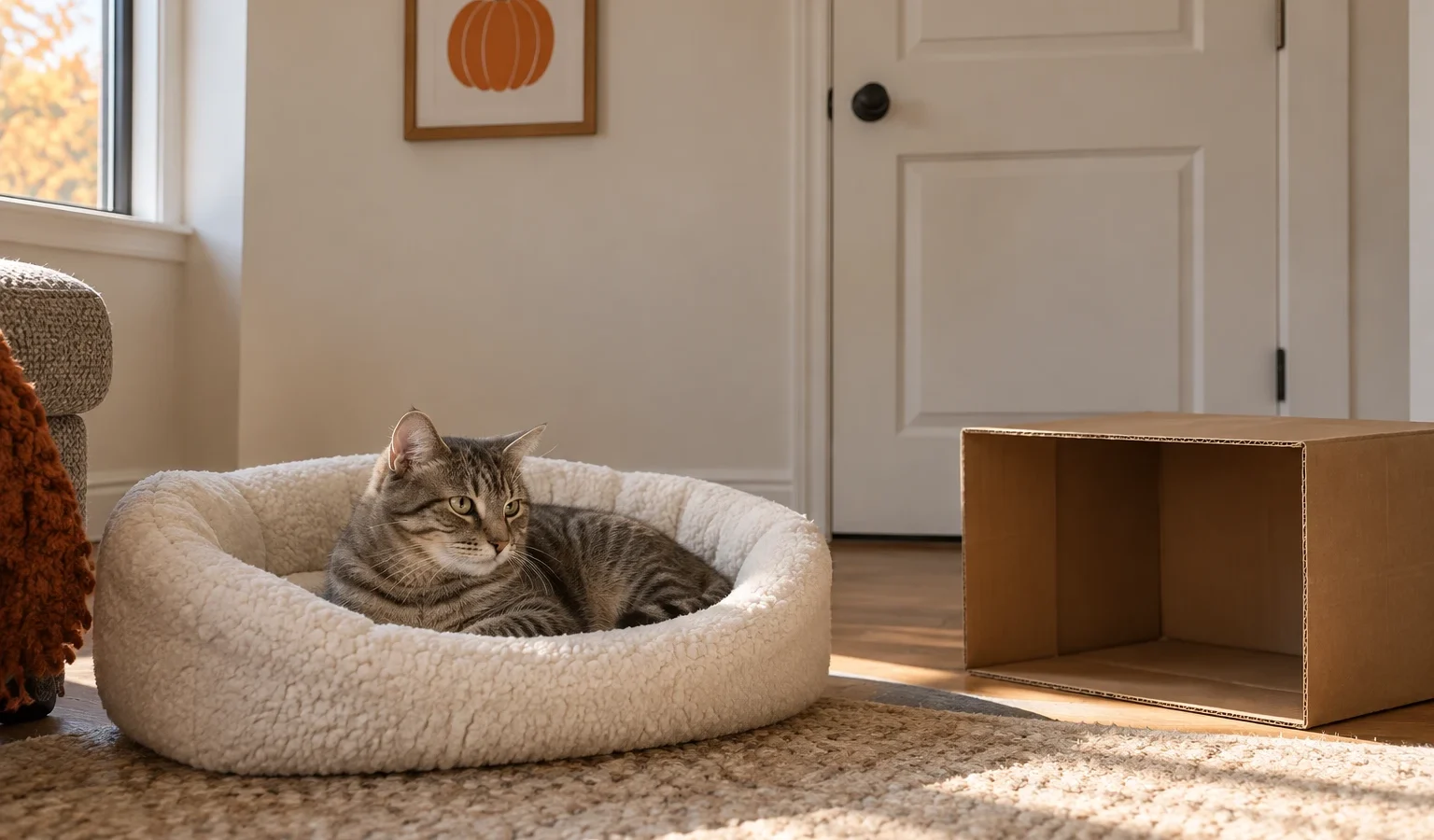
Halloween changes an ordinary front door into a repeated handoff: doorbell, opening, greeting, closing and reset. A cat-friendly plan gives each stage a named person and a visible stop state. It also treats candy, decorations, bags and costume accessories as household items that must be collected and returned to closed storage.
This is editorial home planning, not veterinary advice, a test of a room or a safety guarantee. The Cats Protection Halloween guidance identifies chocolate and candy as risks, recommends keeping decorations and flames out of reach, advises against dressing cats, and suggests keeping cats indoors at night with identification details current. It also points to a quiet, private room with a hiding place. The ASPCA guidance recommends a comfortable room away from the front door during visitor peaks, warns about wires, naked flames and small human costume accessories, and says to contact a veterinarian immediately if toxic ingestion is suspected.
Choose the quiet room before the first visitor
Select a separate closed room with fresh water, suitable litter, a resting place and a hiding location as appropriate for the cat. This is an editorial room check, not feline-care authority. Check it while the home is calm: can the door stay closed, can a household adult enter without opening the front door and can the cat remain undisturbed? A baby gate or a person’s promise to watch the hall is not the same as a closed-room containment plan. If there is no spare closed room, rethink the greeting and visitor workflow and ask your veterinary team for tailored help; do not improvise an unsafe fallback.
Nominate two roles. The greeter owns the front door and keeps visitor traffic from becoming a cat-access decision. The quiet-room checker confirms the cat’s resources and closed door before the first visitor, during any planned check and at the end. One person can hold both roles, but write the name down so a visitor does not accidentally become the supervisor.
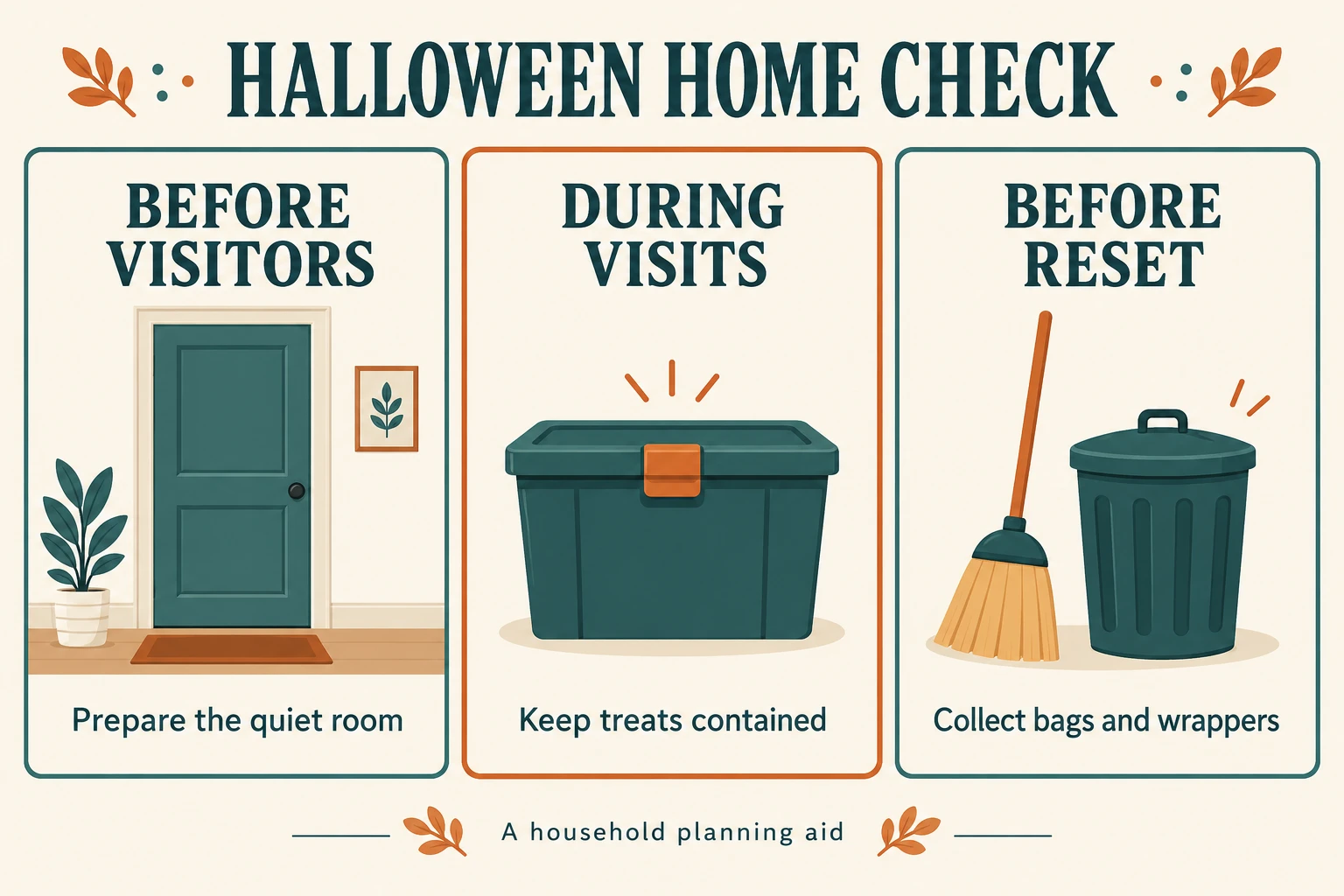
| Stage | Check and record | Named person | Stop state |
|---|---|---|---|
| Before visitors | Quiet room, resources, hiding place, closed door: ___ | Greeter: ___ / checker: ___ | Keep the front door closed while the plan is unresolved |
| During visits | Door-opening routine and visitor route: ___ | Greeter: ___ | Pause greeting if the closed-door control fails |
| Before reset | Child bags, wrappers, accessories and decor pieces accounted for: ___ | Checker: ___ | Keep cat in quiet room until the sweep is complete |
Move candy and decor through a written lifecycle
Before the event, collect candy and decorations in one named staging place away from the cat. Keep chocolate and candy in closed storage and keep cords, hanging pieces and flames out of reach. This article does not give a dose, ingredient or home-treatment instruction. If you suspect the cat has eaten a potentially toxic item, contact a veterinarian immediately rather than waiting for symptoms or trying a DIY remedy.
During visits, serve human candy only from the agreed storage and serving spot. Do not leave a child bag, open wrapper, costume accessory or used decoration beside the entry. Small human accessories can be choking hazards, and a closed quiet-room door does not make loose items in the visitor area disappear. Assign collection to the greeter or another named adult.
After the final visitor, keep the cat in the quiet room while you collect moveable serving items, child bags, wrappers and small accessories. Scan for accessible decor hazards and any naked flame, then remove or secure those hazards according to the household plan. Decor that remains genuinely cat-inaccessible does not have to be removed solely because the event ended. Separate “collected” from “stored”: a bag returned to the entry can still contain wrappers or small accessories. Use the table as a short handoff record, not as a claim that a room is universally safe.
| Item flow | Start location | In-use location | Return action |
|---|---|---|---|
| Candy and chocolate | Closed storage: ___ | Serving spot: ___ | Count/collect and close storage: ___ |
| Decor, cords and hanging pieces | Storage: ___ | Cat-inaccessible display area: ___ | Remove, inspect and store or discard: ___ |
| Child bags and wrappers | Entry plan: ___ | Greeter collection point: ___ | Empty and close or dispose: ___ |
| Costume accessories | Human storage: ___ | Visitor area: ___ | Return to closed storage: ___ |
Keep the quiet-room door closed during greetings
Before answering the entry door, the greeter confirms the cat is inside the quiet room with its planned resources and the quiet-room door is closed. After a visitor enters or leaves, the greeter closes the front door promptly and keeps the quiet-room door closed. Tell guests to ask the greeter or checker if they need anything; they should not open the quiet-room door because the cat is “friendly.”
Do not dress the cat for a photograph. If you want a seasonal image, use a costume-free photo of the cat in a calm familiar setting. Keep the evening indoors and keep identification details current as part of ordinary care; neither step replaces the closed-room workflow.
Run the final reset before ordinary access returns
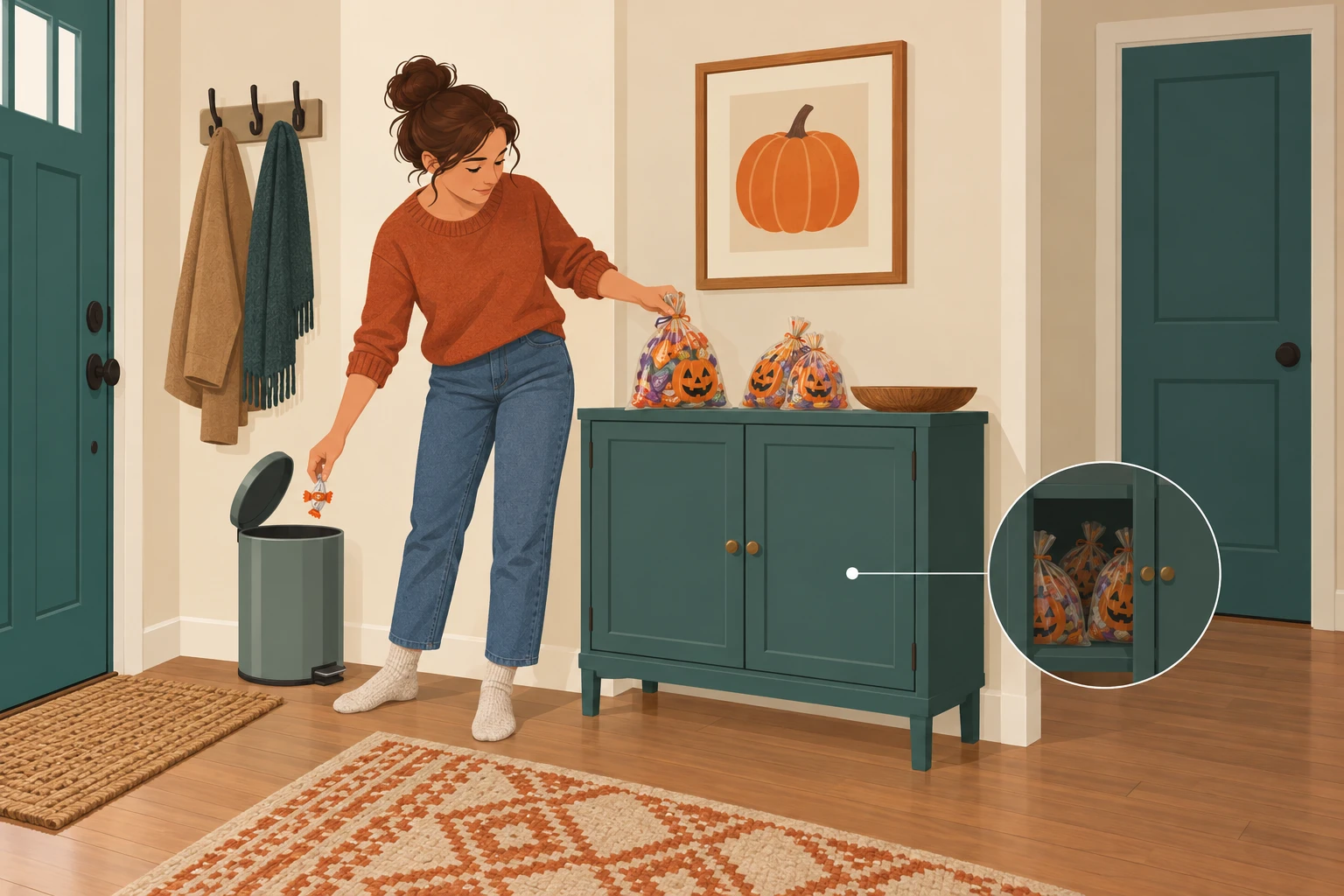
- Keep the cat in the separate closed room while the front entry and visitor area are cleared.
- Collect every child bag, wrapper, candy container and small visitor accessory; check inside bags rather than assuming they are empty.
- Scan the floor, furniture edges and visitor area for accessible decor hazards or any naked flame; remove or secure what the household plan identifies.
- Return moveable items to closed storage or the planned disposal route, and record anything missing or damaged.
- Have the quiet-room checker confirm the cat’s door, resources and indoor route before regular access returns.
If an item is missing, a door was opened unexpectedly, or the checker cannot complete the sweep, keep the cat in the quiet room and resolve the unknown. A later tidy-up is not proof that an earlier exposure did not occur. Suspected toxic ingestion needs immediate veterinary contact.
For the room itself, use the hideaway placement guide to review the quiet room, the sitter handoff checklist to record the two roles, and the cat room planner to map visitor routes. The toy storage plan and houseplant checklist cover separate storage and access decisions.
Sources and scope
- Cats Protection: 5 ways to keep your cat safe at Halloween — candy, decor, flames, costumes, indoor night routine and a quiet room.
- ASPCA: Halloween safety tips — visitor-room separation, decoration and accessory hazards, and immediate veterinary contact for suspected ingestion.
The named roles, lifecycle tables, door routine and final sweep are original editorial planning aids. Images are AI-generated illustrative concepts, not tested arrangements, veterinary assessments or safety certifications.