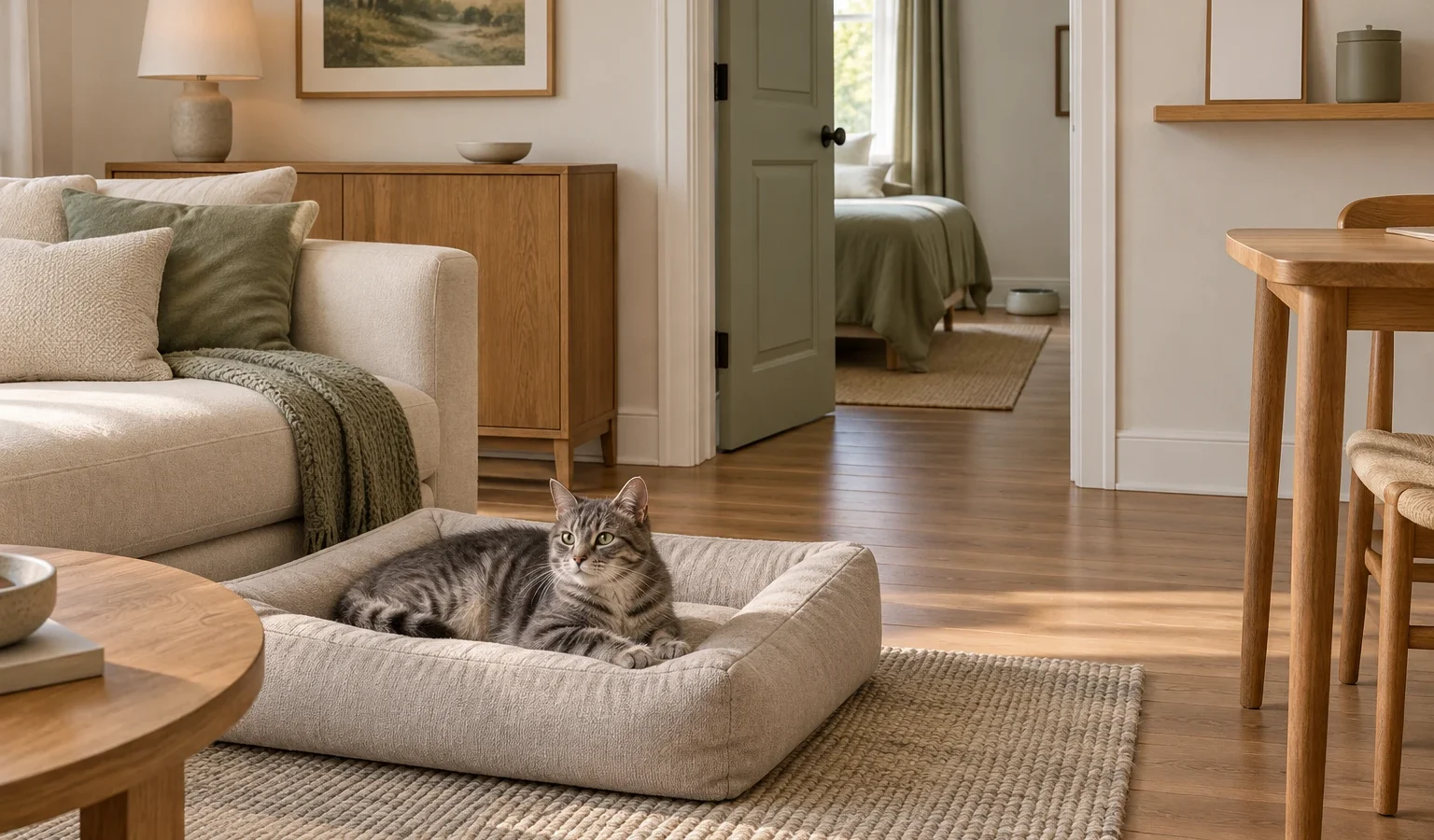
A cat sitter can refill a bowl correctly and still leave it behind a closed interior door. In a small apartment, the care instructions and the home layout need to describe the same arrangement.
This checklist helps you hand over an established home setup: where each resource is, which room states it depends on, and what the sitter checks before leaving. It complements your cat’s individual care plan; it does not set visit frequency, feeding amounts, medication instructions or a universal door policy.
Agree on the care plan before the home walkthrough
Cats Protection’s holiday-care guidance recommends arranging reliable care, meeting a sitter in advance, testing access and providing daily instructions, adequate supplies and veterinary contacts. Different cats may need different levels of care. Agree on visits and any special care with your chosen sitter and veterinary team before departure.
Keep the home worksheet separate from the detailed care instructions. A location note such as “food in the kitchen cupboard” tells someone where to look; it does not specify what to feed. Similarly, a carrier location does not explain your cat’s handling needs. Show the relevant routine instead of expecting a new person to infer it from furniture.
Mark resources and room states together
Feline Veterinary Medical Association’s environmental guidance describes separated resources and places to retreat. Preserve the familiar arrangement when preparing the handoff. Grouping everything beside the front door for human convenience can change the cat’s layout.
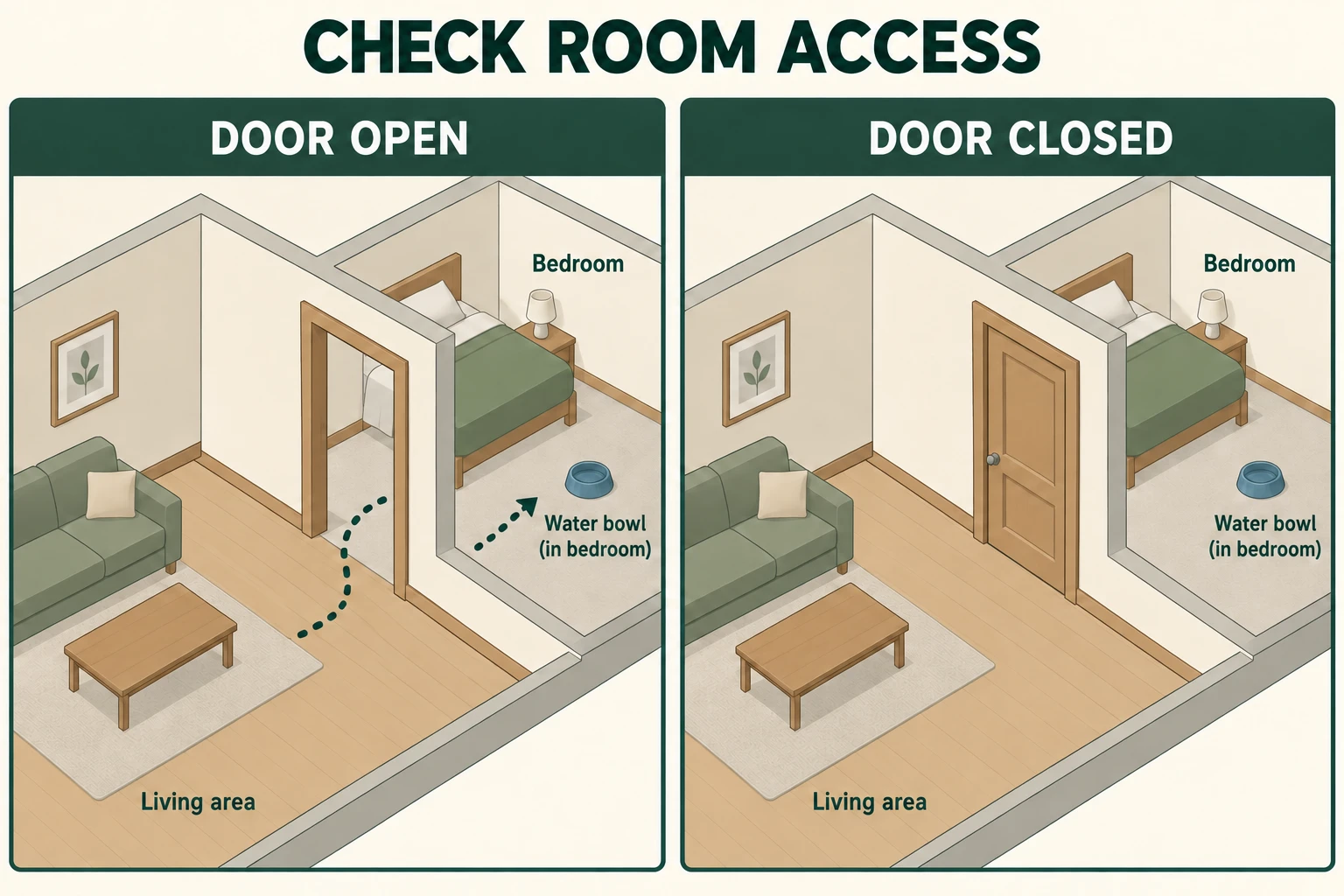
For each familiar location, trace the route from the area the cat normally uses. Note any interior door along it. Distinguish that door from the apartment entrance, an exterior door or a window: they may have different agreed rules. “Check the doors” is too vague if some interior routes must remain available and other spaces must stay inaccessible.
| Resource/location | Related room state | Departure check | If unclear |
|---|---|---|---|
| One familiar water bowl in bedroom | Bedroom route remains available under agreed instructions | Check water and the interior doorway | Ask owner to resolve any conflicting room rule before the trip |
| Carrier in hall cupboard | Cat does not need cupboard access; sitter needs to locate the carrier | Confirm its location during walkthrough | Clarify any change in storage |
| Your location: ___ | Required state: ___ | Actual check: ___ | Contact/action: ___ |
These are fictional worksheet entries, not a complete apartment plan. The water row refers to one existing location; it does not justify removing other water sources. The cupboard row separates human retrieval from cat access. A carrier can be accessible to the sitter without leaving a storage cupboard open to the cat.
Resolve a contradictory instruction before departure
Imagine the written notes say “refresh the bedroom water” and “close every room door before leaving.” The bowl might be full, but the cat outside the bedroom cannot reach it after that interior door closes.
Do not leave the sitter to choose between those statements. Review the room restriction and the water arrangement together, then update the agreed instructions. If a room must stay inaccessible, the owner needs to arrange appropriate accessible resources and explain that arrangement in advance. This is a planning question, not a reason for the sitter to improvise a new care setup mid-visit.
Record the correction in one current copy: “Bedroom rule clarified on ___; resource arrangement agreed with ___.” Do not copy a real access code, address or contact number into a public worksheet example.
Use the walkthrough to check the written notes
- Show the existing stations. Identify each feeding, water, litter and resting location. Refer to the established care routine for amounts, timing and cleaning. Our feeding-station guide helps explain the surrounding layout.
- Show the supply locations. Keep human storage instructions separate from the cat’s routes. Include the actual carrier location; our carrier storage checklist covers retrieval space.
- Explain ordinary retreat places. Note where the cat is commonly seen without treating that note as proof of its current location. Use the agreed approach for checking on the cat; do not force contact just to complete a diagram. Our hideaway guide addresses placement.
- Review the visit-end state. Ask the sitter to describe the intended state in their own words. Correct ambiguity while you are together. A successful walkthrough confirms shared instructions; it does not guarantee that every future visit will go to plan.
Add a visit-end check, not another care schedule
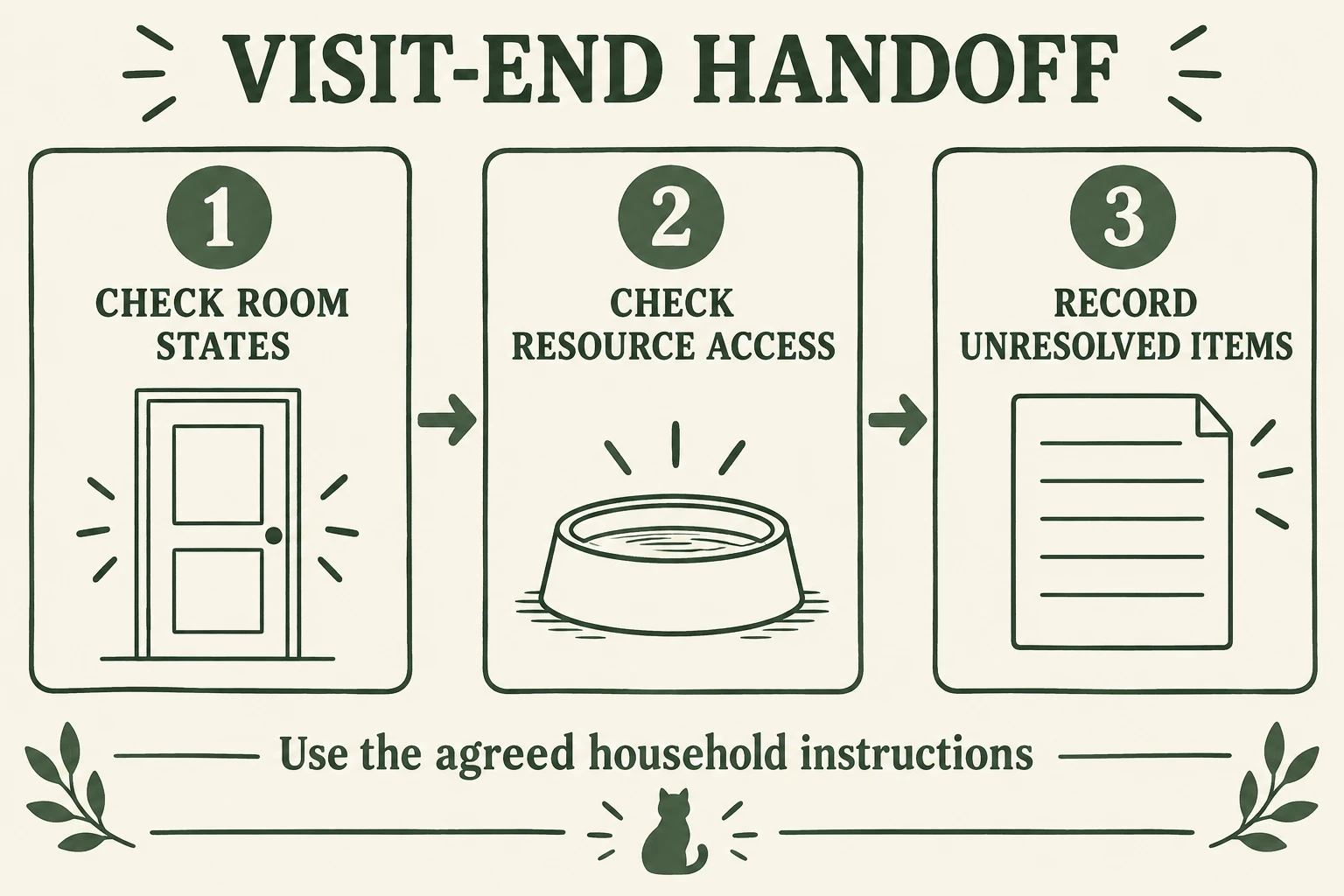
After completing the care tasks, the sitter checks the agreed room states and the routes to the cat’s resources. They then record anything unresolved and follow the established contact plan. A missed observation should be recorded as unknown, not converted into “everything normal.”
Copyable visit-end note: Visit date/time: __. Household instruction version: __. Resource/room state checked: __. Observations: __. Task incomplete or uncertain: __. Contact/action taken: __. Owner response or next agreed step: __.
The contact plan should be available to the sitter through your private handoff. If the cat is unwell, missing, inaccessible or unable to receive agreed essential care, use the relevant veterinary or urgent contact arrangement rather than waiting for the next routine update. This article supplies no treatment advice or instructions to change prescribed care.
Keep familiar play and private details in the right place
Cats Protection advises keeping string-like toys out of reach when not being used. Explain which familiar play items require supervision and where they are put away afterward. Our toy-storage guide helps document that storage.
Use a simple sketch or the free cat-room planner to orient the sitter. Share actual entry arrangements and contact details privately with the authorized caregiver. Keep those details out of public downloads, screenshots and example maps.
Date the instructions, remove obsolete copies from the handoff, and tell the sitter about any subsequent layout change. The useful result is a consistent care plan, home sketch and visit-end record describing the same setup.
If someone else is greeting visitors or checking the cat’s room, add the Halloween household handoff to the sitter notes before the evening begins.
If someone else may need to find the kit, pair the sitter’s home handoff with the cat emergency kit storage map so packed, elsewhere and replacement-needed states are visible.
For a sitter who may find a paused cleaning session, pair the home handoff with the parts-and-sink fountain cleaning plan so the water backup and component status are visible.
If a sitter may use the desk or bedside area, add the phone and laptop charger put-away plan to the private handoff so the kit owner and return check are clear.
Sources and scope
- Cats Protection: Going on Holiday Without Your Cat — preparing for a sitter and arranging care.
- Feline Veterinary Medical Association: What Your Cat Needs to Feel Secure — resource and retreat principles.
Editorial household-planning guidance. Worksheet examples and AI images are illustrative. We have not tested the pictured home or established a clinical or escape-proof safety standard.