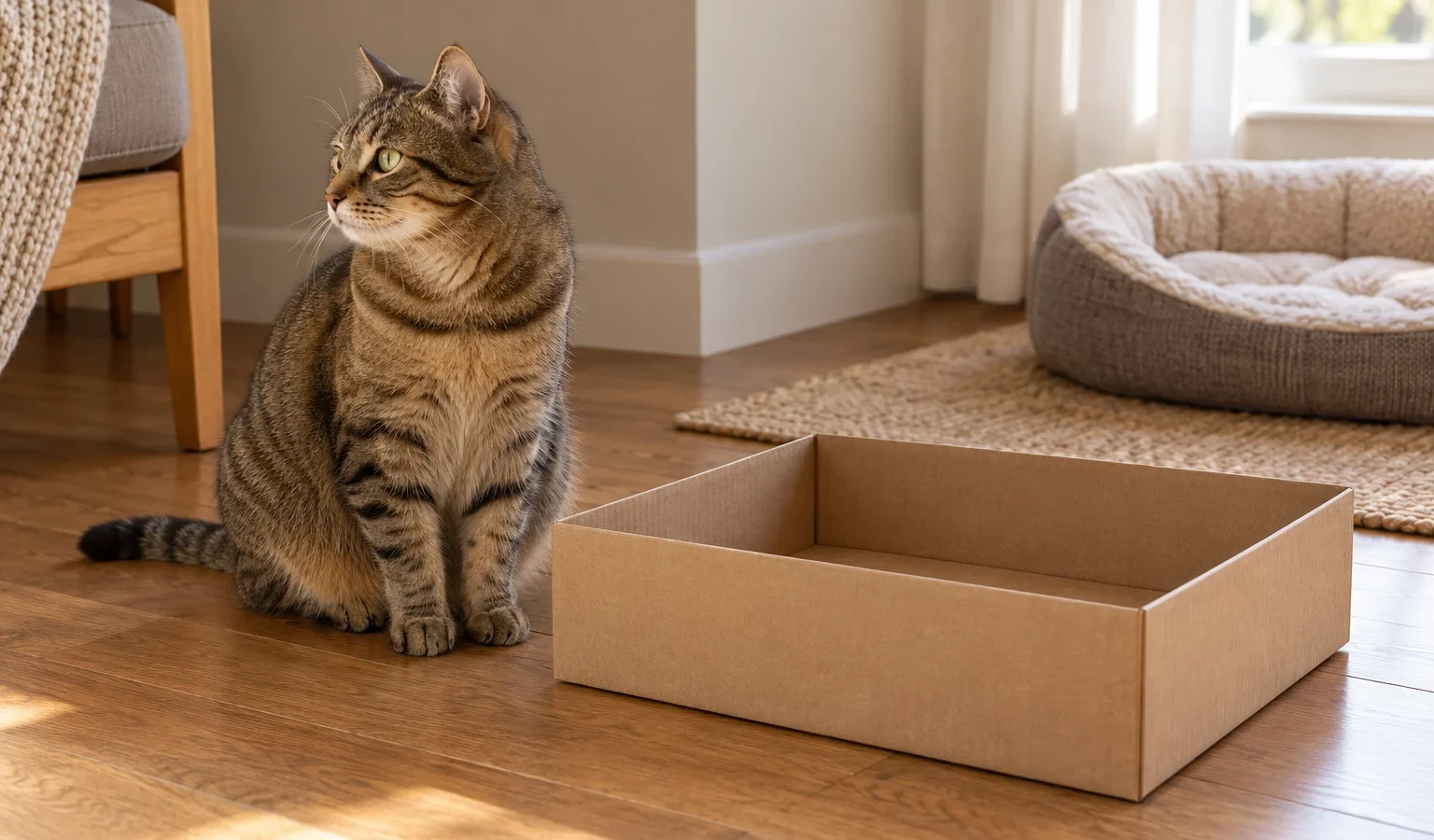
A cardboard box is not automatically a safe cat resource because it came from a delivery. Keep the cat away while opening it, remove loose packaging and inspect the empty box’s contents history, condition and edges before deciding whether to offer it voluntarily.
The PDSA cardboard-house guidance discusses removing packaging hazards and checking a box. The ASPCA enrichment guidance and BC SPCA enrichment tips provide broader play and environment context. Apply those sources narrowly here: an empty, known-condition box may be an optional enrichment item, but editorial observation cannot certify its materials, contents or safety.
Inspect an empty box before deciding
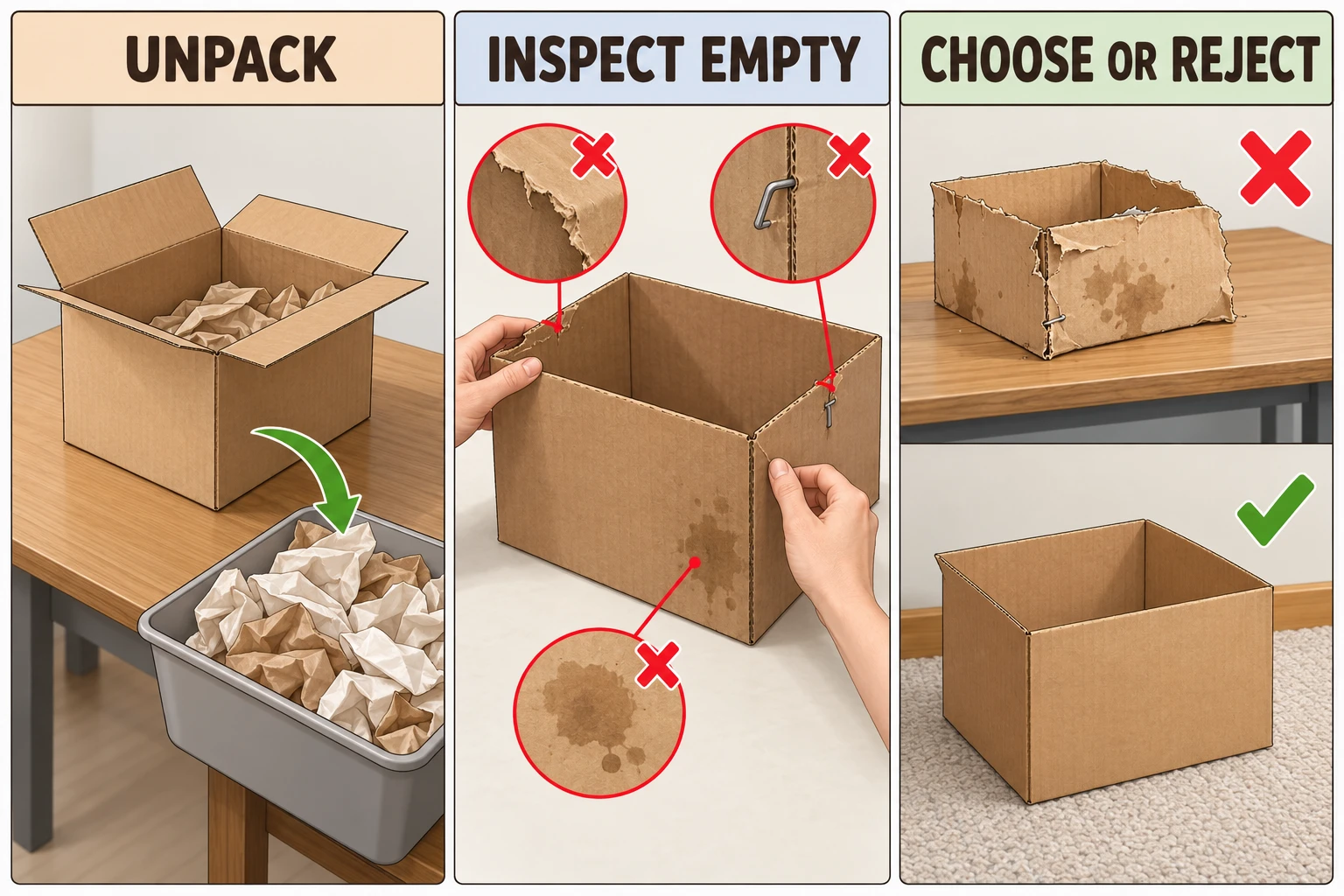
Keep the cat away while you empty the package. Read or retain any information needed about what was inside; an unknown former contents history is a reason to reject the box. Look at the whole empty surface and edges. Reject it if it is torn, damp, dirty, crushed, shedding material or otherwise difficult to describe. Do not try to rescue an uncertain box by modifying it, and do not call a clean-looking package certified non-toxic.
| Question | Accept only if you can answer | Editorial decision |
|---|---|---|
| Contents | What was in the box is known and no residue or unknown material remains. | Unknown: reject. |
| Condition | The empty box is dry, intact and clean enough to keep observing. | Wet, torn or dirty: reject. |
| Use | The box can sit empty while the cat approaches and leaves voluntarily. | Cannot observe without handling the cat: do not offer it. |
Offer choice, never a forced fit
Place the empty box where you can supervise ordinary exploration without blocking a route, resource or familiar retreat. Do not put, hold or force the cat into it to test whether the space fits. A cat may ignore it, enter briefly or leave quickly; those are observations, not a safety guarantee. Keep the cat’s familiar retreat available and do not replace it with the delivery box.
This check is not a carrier or transport plan. It does not establish a universal opening size, a weight rating or a suitable arrangement for every cat. If the box becomes wet, shifts into a walkway or creates an unknown condition, remove it from the cat’s area. Supervision and voluntary use do not replace checking the box and removing it when its condition changes.
Invented rejection example
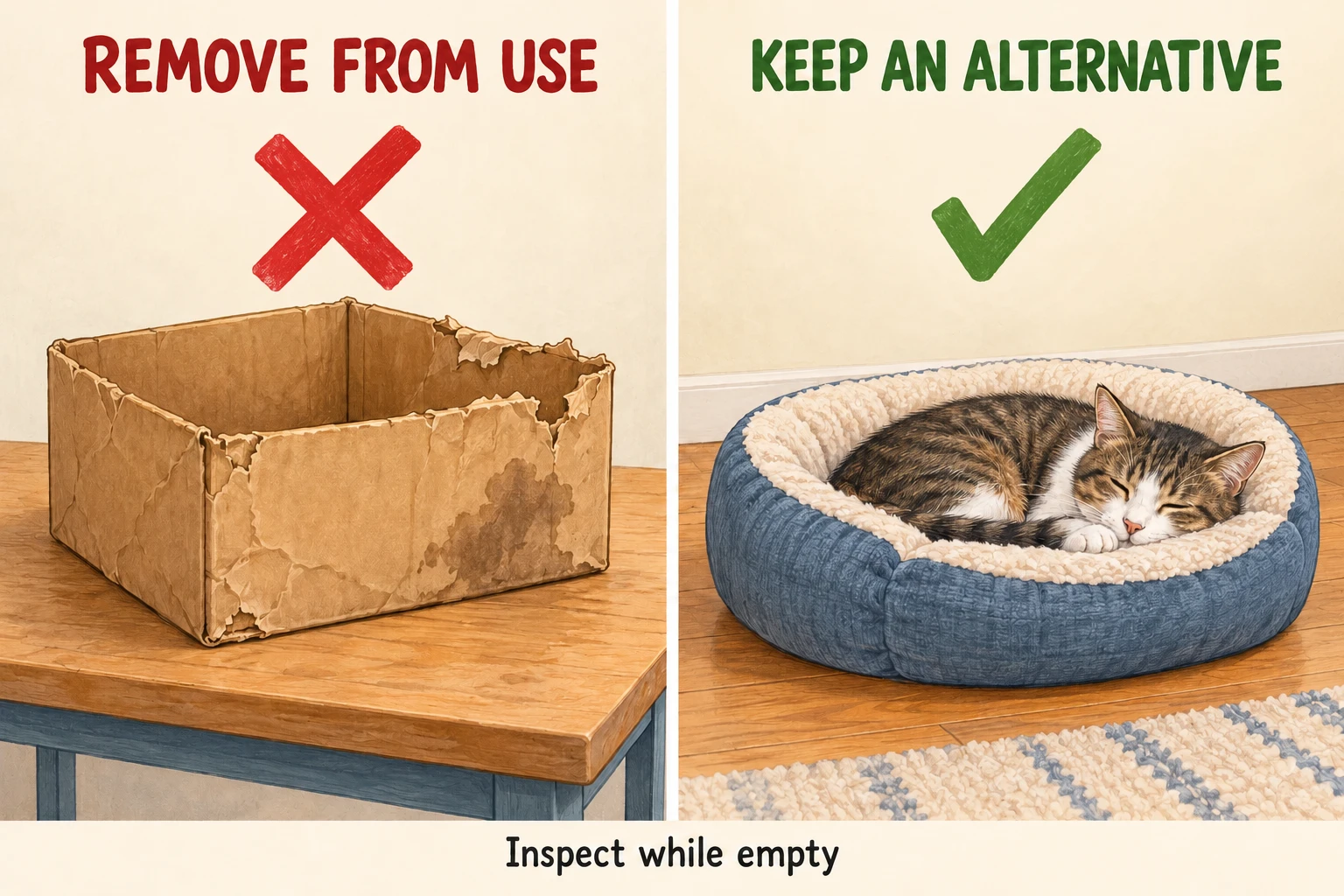
This is an invented household example, not a personal test. A delivery arrives in a box that looks usable from the outside. During empty-box inspection, one corner is torn, the base is damp and nobody can confirm what was previously packed inside. The decision is reject: the box never enters the cat’s room, and no cat is placed in it or invited to investigate. The household keeps the familiar retreat and chooses no replacement until a known-condition option is available.
Run the retirement check
Recheck an offered box while it remains empty and before the cat uses it again. Retire it when its condition is no longer dry and intact, when its former contents become uncertain, when it starts to shed or collapse, or when it interferes with an ordinary route. Retirement means removing it from the cat’s area, not persuading the cat to finish using it. Keep the familiar retreat available before and after removal.
| Retirement prompt | Record |
|---|---|
| Condition changed? | Dry and intact today? __________________ |
| History still known? | Contents and surface remain known? __________________ |
| Room impact? | Route, resource and familiar retreat remain clear? __________________ |
| Decision | Keep for observation / remove from cat’s area: __________________ |
Use the hideaway placement guide for the separate question of retreat location, the toy-drawer rotation plan for toy storage, and the cat-room planning guide for the wider room context. None of those links turns an ordinary package into a certified cat product.
If you suspect ingestion or an injury, contact a veterinarian. Do not use this editorial check as treatment or as a substitute for individual veterinary advice.
Sources and further reading
- PDSA: Build your own cardboard cat house — packaging and box inspection context.
- ASPCA: Feline DIY enrichment — general enrichment context.
- BC SPCA: How to keep your cat happy — broader feline-enrichment context.
The accept-or-reject example and retirement card are original editorial planning aids. Images are AI concept illustrations, not real tests, toxicity findings, medical advice or safety guarantees.