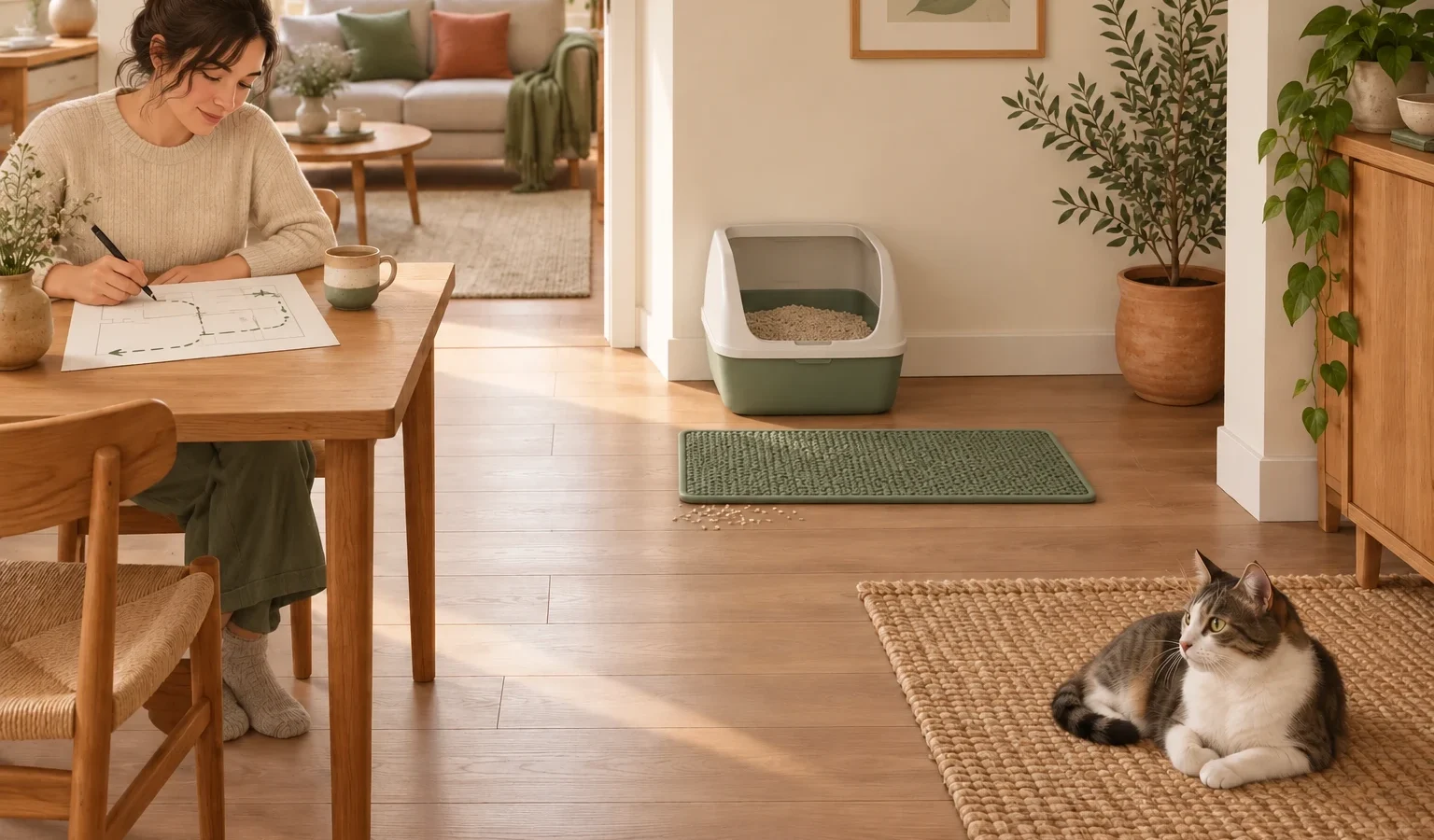
Litter tracking is easiest to manage when you follow the short route after the box: the cat exits, particles land in the first passing area, a person crosses the room, and the mat or floor is cleaned. In a small apartment, that route can overlap with a doorway, a chair or a resting place. This plan helps you inspect the route and reset it without changing the familiar box or litter just to chase a cleaner-looking floor.
Keep the box, litter and ordinary access that already work for your cat. A mat can be useful, but it is only one part of the route. Do not force a cat across a mat, narrow the exit, switch to a top-entry box, shave paws or treat scattered particles as a diagnosis. If toileting changes, the cat avoids the box, or appears uncomfortable, pause the layout exercise and contact your veterinary team.
Start at the exit, not the farthest particle
Stand back and look at the box after the cat has left voluntarily. Mark four observations on paper: the box opening, the first place particles are visible, the human path past the box and the nearest place where a mat can be lifted. Record what you can see rather than counting grains or claiming that a particular surface catches everything.
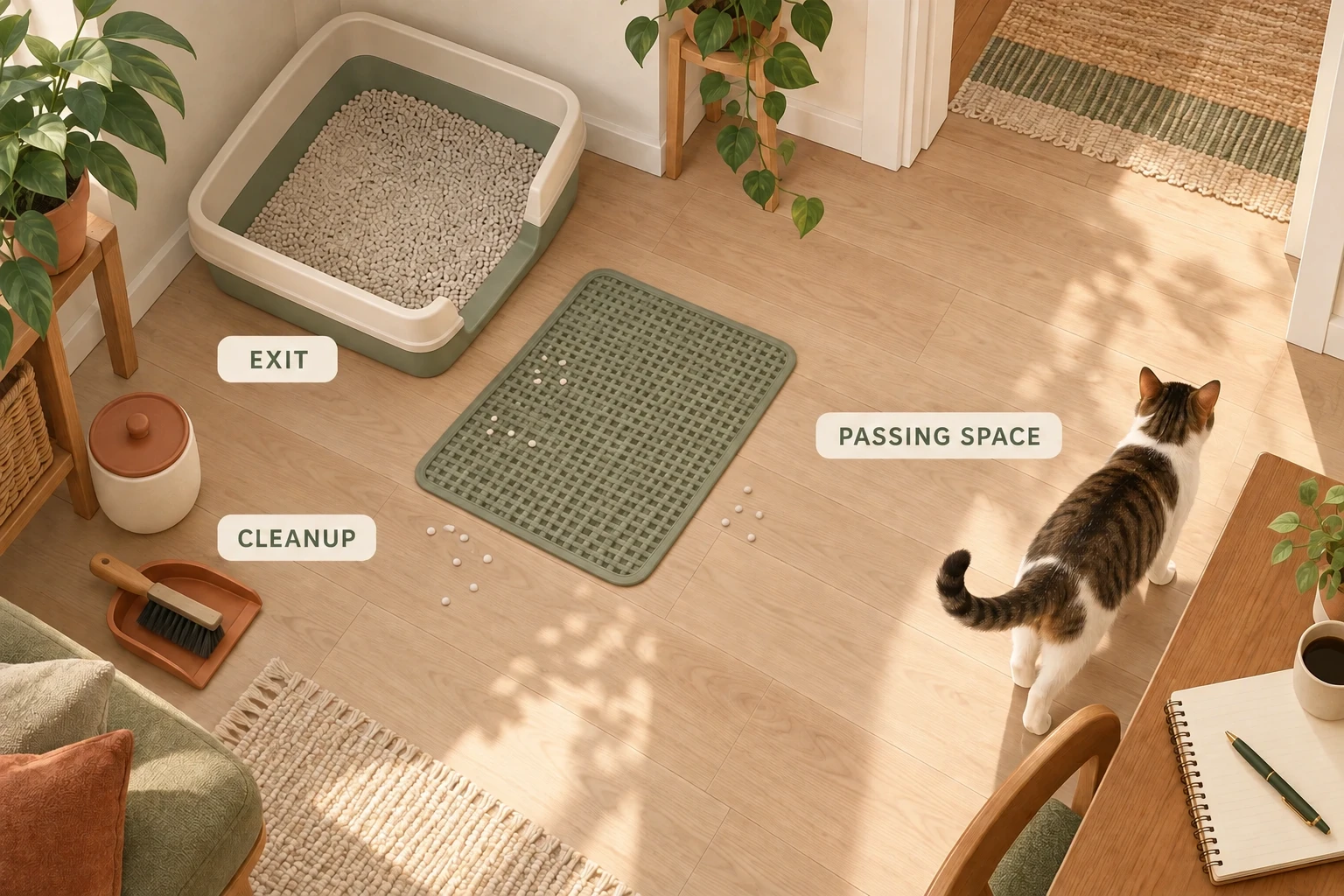
| Point on the route | Write one observable answer |
|---|---|
| Exit | Where does the cat step after leaving the box? Is the ordinary exit still open? |
| First landing area | Where do you first see loose litter: on the mat, beside it or farther away? |
| Human passage | Can a person walk past without stepping on the mat or blocking the cat’s route? |
| Reset point | Where can the mat be lifted, cleaned and returned without moving the box? |
ASPCA describes easy access, location and cleaning as relevant litter-box considerations. Apply that guidance to this narrow check: the cat should retain a usable route and the household should be able to keep the area clean. The inspection does not prove why particles appear and does not certify a layout.
Keep a passing route for both cat and person
Use the smallest change that leaves the familiar arrangement understandable. A mat that reaches into a doorway may collect particles while creating a trip point or making the exit feel tight. A mat that cannot be pulled out without lifting the box will be difficult to reset. Move bags, stools or stored supplies away from the route rather than adding a barrier around the cat.
Walk the route once with the apartment in its normal state: doors open as they usually are, chairs pulled out when someone sits down and the nearest resting place available. Then ask three practical questions: Can the cat leave without being guided? Can a person reach the mat edge? Can you clean beneath the mat without relocating the box? If any answer is no, record the obstruction and stop before rearranging more.
The small-space litter layout guide covers choosing a tray location. Use this exit-to-cleanup plan after that location is established. The hidden litter-box guide covers enclosure access; scattered litter alone is not a reason to enclose a box or change its entrance. If a vacuum is needed, use the vacuuming route and refuge plan to preserve a quiet place while the human-only cleaning happens.
Choose a mat reset that can happen without pressure
A washable mat is a household option, not a required product and not a guarantee of a clean floor. Keep it flat and stable enough for the people who use the room, with its edges visible during the normal route. The cat should be able to leave the box without being placed on it or held over it. If the cat avoids the route after a change, return to the familiar arrangement and discuss the change with your veterinary team if toileting is affected.
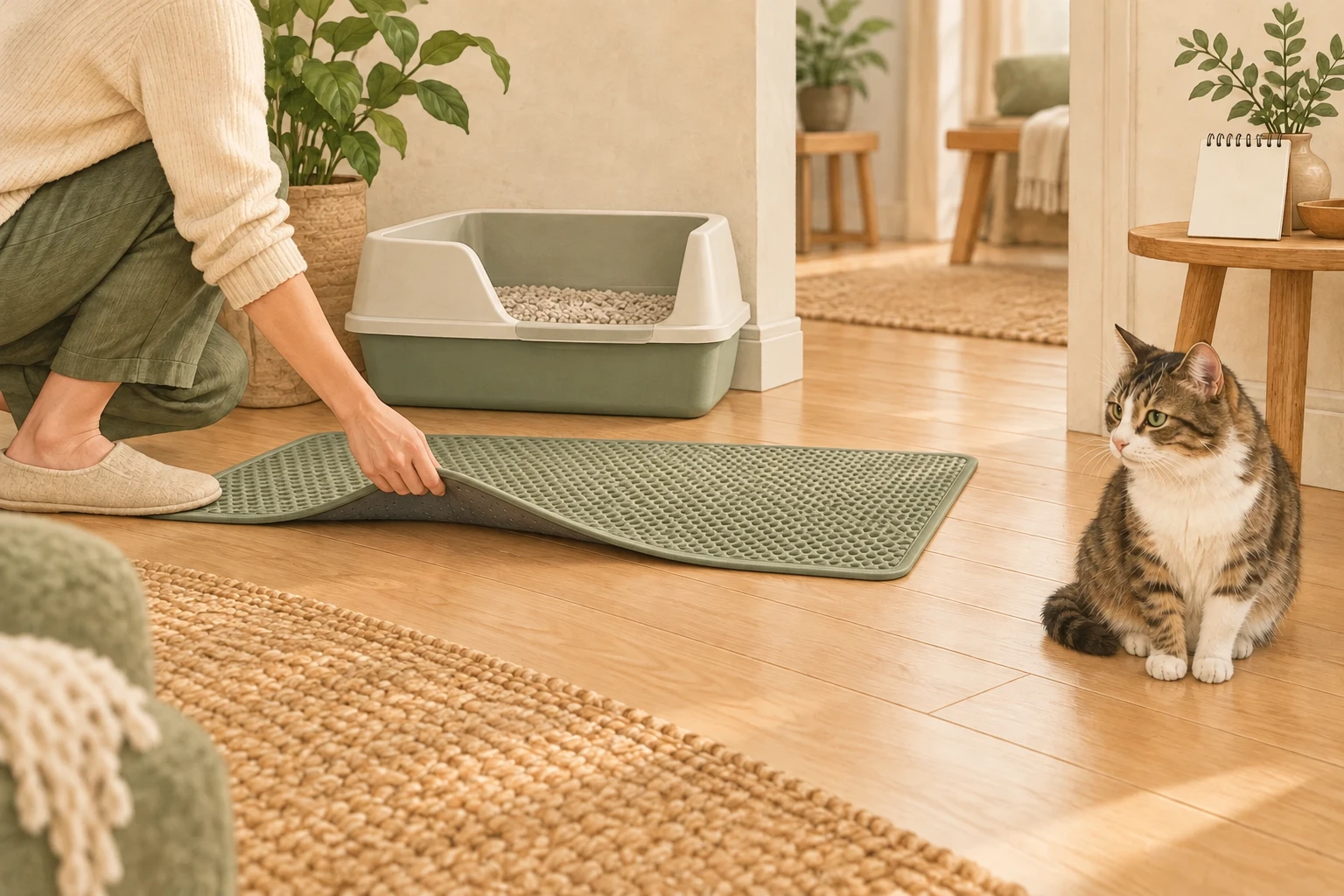
| Reset step | Stop rule |
|---|---|
| Move the person | Keep the cat’s ordinary route open; do not carry or guide the cat across the mat. |
| Lift the mat | Stop if lifting it requires moving the box, blocking the exit or stepping into a narrow passage. |
| Clean and dry | Follow the mat’s own care instructions; keep it out of the route until ready to return. |
| Return and look | Return the mat only when it lies as before and the exit and human route remain clear. |
Cats Protection advises removing deposits twice a day, or more often if needed, and keeping trays in quiet, accessible locations. ASPCA advises scooping at least daily. Those are care-frequency sources, not a reason to delay cleaning until it is convenient. A surface reset should fit around the care routine rather than replace it.
Change one household feature and observe
If the route needs improvement, change one feature: for example, move a loose object away from the exit or place the existing washable mat where it can be lifted. Do not change litter, box style, location and mat at the same time. The record below is an observation worksheet, not a controlled experiment and not a test of a product’s performance.
| Record | Your note |
|---|---|
| Baseline | Box and litter already in use; ordinary exit and first visible particle area: ___ |
| One change | Only feature changed today: ___ Date and person: ___ |
| Access | Cat’s voluntary route remained open? Human passing route remained clear? ___ |
| Cleanup | Mat or floor reset completed according to its care instructions? ___ |
| Next observation | What was visibly different on the next ordinary check? ___ |
| Stop state | Any toileting change, avoidance, discomfort or blocked access? Restore the familiar route and contact the veterinary team where appropriate. |
Use the cat room planner if you need a simple place to map the box, door and human route. Keep the worksheet factual: “particles beside mat” is useful; “mat solved tracking” is an unsupported conclusion. The bedding wash-and-return plan can help when a washable textile shares the same drying footprint.
When the route should stay unchanged
Keep the familiar box and litter in place while assessing a particle trail. If a mat is difficult to clean or return without narrowing the exit, leave that mat out of the route until it can be reset properly. Do not switch to a top-entry box or a new litter for a cleaner photograph. Do not force the cat to pause on a mat, handle its paws as part of this layout check, or treat a few particles as evidence of illness. Household observations can guide a practical cleanup conversation; they cannot certify comfort, suitability or a clean floor.
A sudden change in toileting, repeated box avoidance or apparent discomfort needs veterinary advice; straining or apparent pain warrants prompt veterinary attention. ASPCA lists medical and stress-related causes of litter-box problems, and Cats Protection likewise recommends veterinary advice for sudden toileting changes. A tracking route is a cleaning plan, not a clinical explanation.
Sources and scope
- ASPCA: Litter Box Problems — access, cleaning and escalation boundaries.
- Cats Protection: Cats & Toileting — care frequency, accessible trays and sudden-change guidance.
- Purina: Stop Cat Litter Tracking — common mat and daily-cleaning suggestions reviewed as existing advice.
The exit route, reset sequence and worksheet are original editorial planning aids. Images are AI-generated illustrative concepts. They do not test a mat, certify a floor or replace product instructions or veterinary advice.