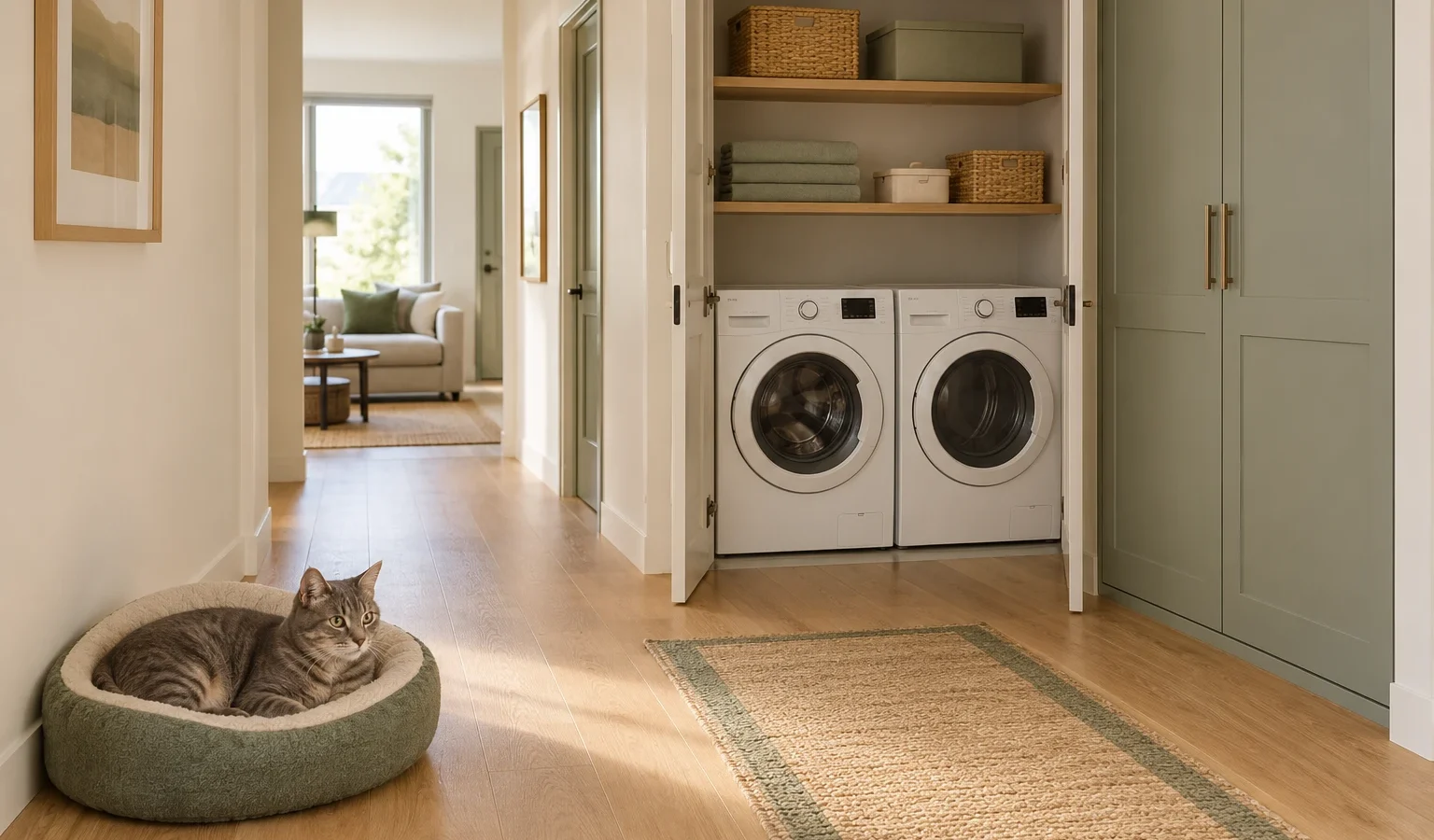
A laundry area has two different boundaries: the appliance boundary around a washer or dryer, and the room boundary around the whole area. A cat-safe setup records both. A closed washer door does not by itself decide whether the cat can enter the room, and a closed room door does not prove the appliance is ready to use.
Use this checklist to document an existing layout, storage locations and stop conditions. It is a household-planning worksheet, not a build plan, appliance repair guide or substitute for the manufacturer manual and veterinary advice.
Start with the appliance and room states
Cats Protection’s cat-safety guidance advises keeping washing machine and tumble dryer doors firmly shut when not in use and blocking access to places where a cat could become trapped. Apply those instructions to the actual room boundary as well as the appliance doors. Check every time before starting a cycle, after an interruption and before leaving the area.
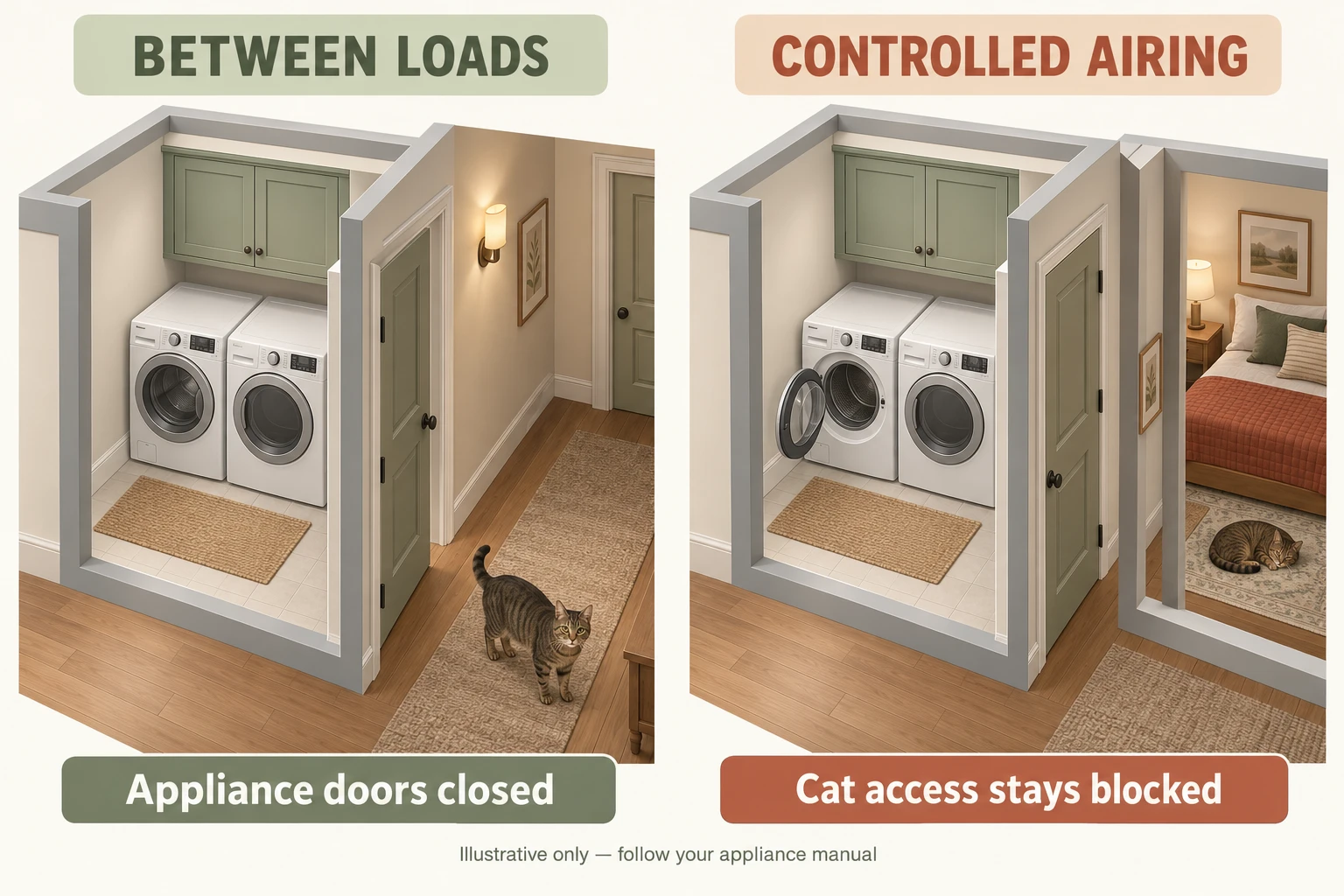
| Check | Agreed state | Observed state | Stop if |
|---|---|---|---|
| Washer door | Closed when not in use, unless the manual requires another state | ___ | The manual requirement is unknown or the door cannot be secured as required |
| Dryer door | Closed when not in use, unless the manual requires another state | ___ | The door, drum or seal needs repair or inspection |
| Room access | Cat excluded or allowed only under the written household plan | ___ | The boundary cannot be maintained for the entire period |
| Route around machines | No unreviewed gap or trap area in the cat’s route | ___ | A gap or access point cannot be checked safely |
If the manufacturer manual requires the door to remain open for airing, follow the manual and keep cat access physically excluded for the entire airing period. Do not force the door closed against a vendor instruction. If you cannot maintain that boundary, stop and replan the arrangement. Do not improvise a cover, wedge or clearance measurement.
Before each load: locate, inspect, close, start
- Locate every cat by sight outside the laundry work area before opening or loading a machine. A call or an assumption about a usual sleeping place is not confirmation.
- Inspect the drum and check the clothes as you load them. Keep the cat outside the controlled work area throughout loading.
- Close the appliance door and confirm the cat is still outside the boundary immediately before starting.
- If you leave or someone reopens the machine, repeat the location and drum checks before continuing.
Write the responsible person beside the machine on your private worksheet. An open drum, an unknown cat location or a boundary that another person may open is a stop condition, even when the previous load went smoothly.
Choose the boundary for the actual apartment
A laundry room with a solid entrance is easier to document: the room door is the main access state, while the appliance doors have their own state. A kitchen laundry niche has no separate room boundary. In that case, the household plan must exclude the cat from the whole kitchen area during the relevant activity, with food, water, litter and retreat resources verified outside that boundary. A visual divider alone is not a proven barrier.
Separate-room example: “Laundry room door closed whenever the washer or dryer is unattended; appliance doors follow the manual; sitter checks the room before starting and after finishing.” Record the exact household rule privately, then test that it can be maintained.
Tiny-apartment example: A 30-square-metre flat has a washer under the kitchen counter, litter box in the hall and water in the living area. The worksheet marks the kitchen as the temporary no-cat boundary during loading and unloading, verifies the litter and water routes outside it, and stops if another person cannot keep the kitchen excluded for the whole task. It does not move the litter box or prescribe a new route.
Make storage a separate worksheet
ASPCA Poison Control notes that laundry detergent and liquid pods can irritate or cause serious problems, while dryer sheets and fabric softeners can cause chemical burns. Swallowed dryer sheets can also cause an intestinal obstruction. Keep products inaccessible according to their labels and the household storage plan. If exposure is suspected, contact a veterinarian or poison control immediately; the guide is not a case assessment. Do not use this article for dosing, home remedies or detailed first aid.
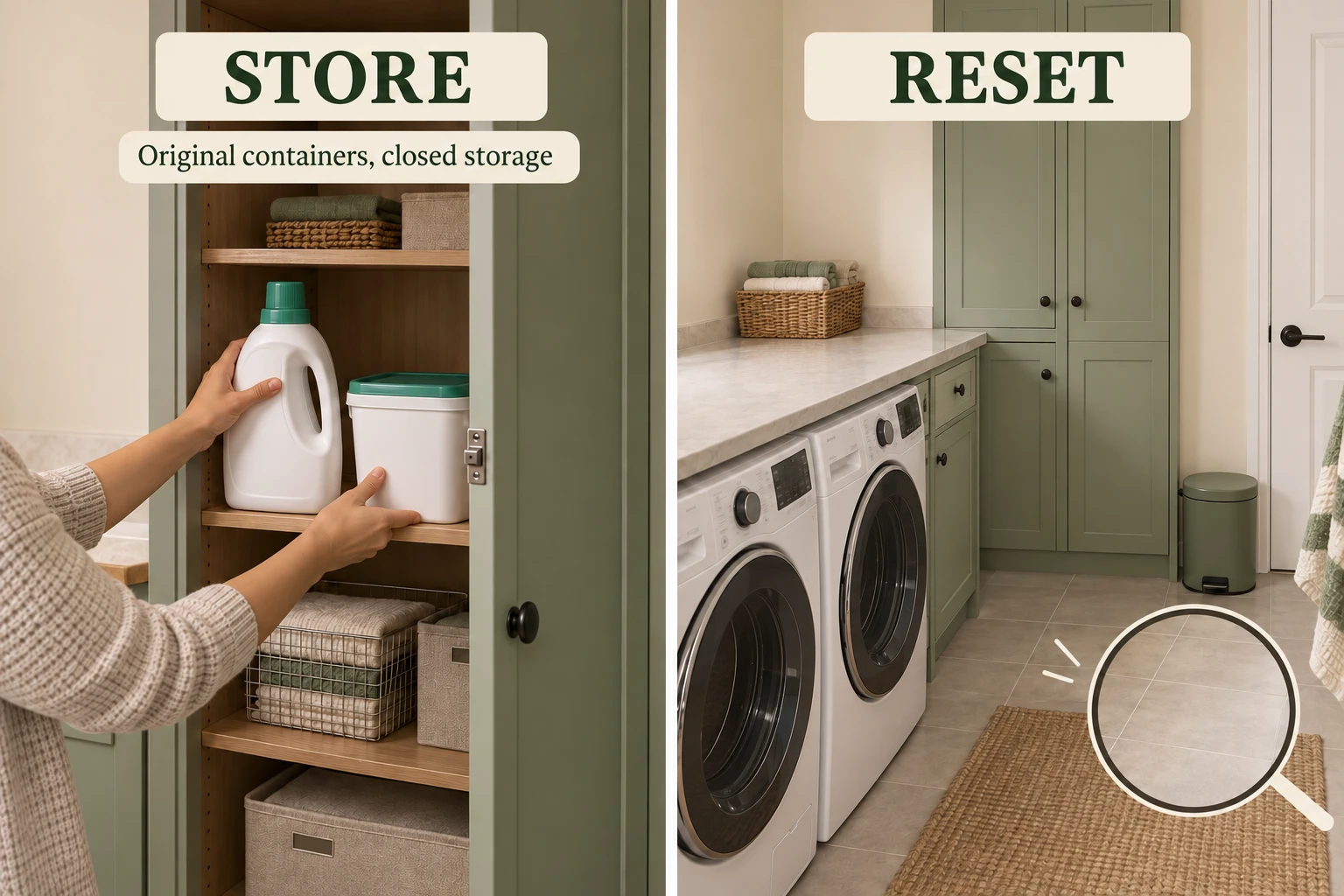
| Storage item | Where it is kept | Cat-access state | Stop if |
|---|---|---|---|
| Detergent or pods | ___ | Inaccessible under the household plan | Container is damaged, open or reachable |
| Dryer sheets or softener | ___ | Inaccessible under the household plan | Loose products are left out after use |
| Cleaning supplies | ___ | Stored according to labels | Label directions or storage state is unknown |
| Used laundry | ___ | Basket or hamper state: ___ | Small items, strings or chemicals are accessible |
Storage access and room access are separate entries. A latched cupboard may protect a product while the open kitchen still needs a temporary cat boundary. Conversely, a closed laundry-room door may restrict the cat while a sitter still needs a clear, agreed way to retrieve supplies.
Use a stop-and-replan rule
- Stop before loading if you cannot inspect the washer or dryer drum.
- Stop before starting if the cat’s room boundary cannot be maintained for the whole activity.
- Stop before leaving if an appliance door, product container or room state differs from the written plan.
- Stop and contact the veterinary or poison-control route immediately if product exposure is suspected.
Do not turn an unknown observation into “safe.” Write “not checked,” identify who will resolve it and keep the appliance unused until the household plan is clear. Ask a qualified installer about any physical appliance or ventilation change; this worksheet does not supply construction dimensions.
Connect laundry access to the rest of the room plan
Use the cat room planner to mark the laundry boundary alongside the cat’s ordinary routes. In a compact home, compare it with the small-space litter access guide so a temporary exclusion does not hide an access conflict. A retreat location documented in the hideaway placement guide should remain outside any temporary boundary when the plan requires it. If a sitter will operate the machines, use the sitter home setup handoff checklist to record the private room and appliance instructions.
Date the worksheet, remove obsolete copies and review it after any appliance, storage or room-layout change. The useful result is a current record of appliance-door state, room-access state, storage state and the person responsible for resolving an unknown.
For a vacuum stored near laundry equipment, add the vacuum cleanup and storage check so the unplugged machine, cord and cat’s route are checked separately.
When food and laundry supplies share a tight utility area, add the cat food storage worksheet to the access and storage handoff so the retained label and container reset have a named place.
When a shared utility room also contains a window treatment, add the window-treatment check to the same handoff record and keep any unresolved cat-access state visible.
When the laundry area also stores cleaning products, use the cat bedding label-to-return plan alongside the room-access checklist so the bed’s care record and the room’s storage boundary are checked separately.
Sources and scope
- Cats Protection: Keeping Your Cat Safe — appliance-door and trapping-access precautions.
- ASPCA Poison Control: Poisonous Household Products — laundry-product hazards and urgent contact guidance.
Editorial household-planning guidance. Images are AI illustrations, not tested arrangements. This article does not provide appliance repair, construction, clinical assessment, dosing or guarantees.