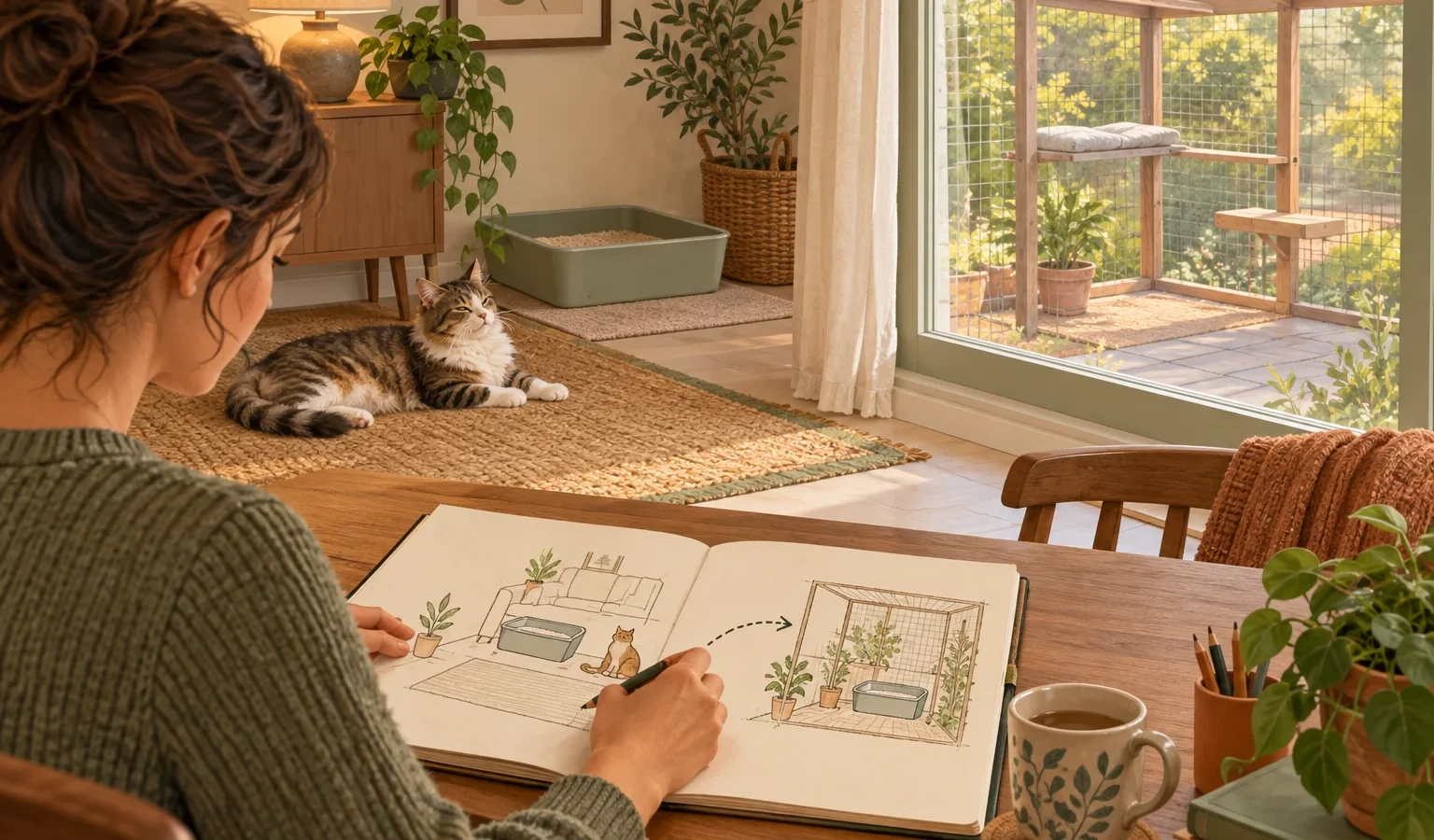
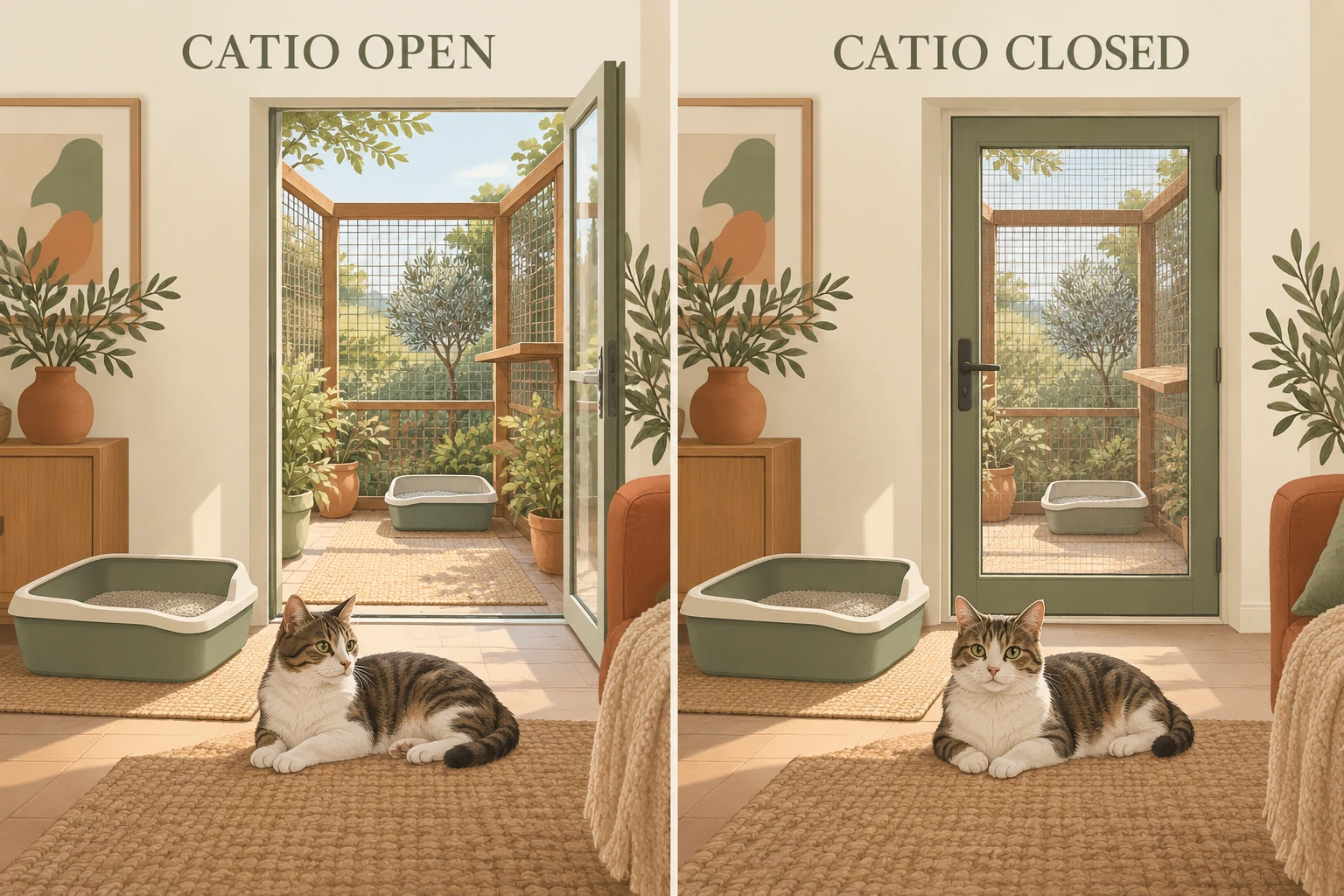
A litter box in a catio changes the household routine in two ways. The catio may be open and available, or it may be closed for weather, cleaning or another household reason. The tray also has to be reached, scooped, emptied or removed by a person without turning the catio into a construction project. Plan both states before treating an extra tray as part of the room.
Keep the familiar indoor litter option available while you evaluate an additional catio tray. This is a household planning worksheet, not a catio design, containment installation or medical plan. If toileting changes, the cat stops using a box, or access seems difficult, pause the layout experiment and contact your veterinary team.
Record the two states first
Cats Protection’s indoor-cat guidance describes indoor resources as part of the cat’s environment. For this plan, write down what remains available inside before you add anything outside. An extra tray can be a choice; it should not silently become the only route to a toilet.
| State | Record and stop rule |
|---|---|
| Normal access | When the catio is available, record the indoor tray, additional tray, person responsible and clear human route. Stop: the indoor option is removed or the cat’s choice is being forced. |
| Catio closed | Record how the indoor tray remains reachable and who checks the catio tray. Stop: weather, damage or a closed access point makes the tray condition unknown. |
| Service visit | Record where a person stands, how the tray is removed or scooped and where waste goes. Stop: the route requires moving the cat, climbing, dismantling or guessing. |
Check whether the location can be serviced
A catio tray may look convenient from the cat’s side while being awkward from the human side. Stand outside the empty enclosure and trace the ordinary cleaning route: approach, scoop, bag or container, handwashing and return. Mark the point where the tray can be lifted or emptied without carrying waste through the cat’s resting area. This is an editorial route check, not a recommendation to build a hatch, flap or raised box.
ASPCA notes that cats need easy access to their boxes and that cleaning, location and access can be associated with litter-box problems. Apply that source narrowly: observe whether the cat can reach the planned option and whether the household can keep it usable. Do not infer a behavioral diagnosis from one missed visit or promise that an outdoor tray will solve a problem.
For a weather or access interruption, record the indoor option as the active route. Do not confine a cat in the catio to make the tray choice work, and do not assume a roof, screen or door makes an area suitable in every condition. If the enclosure is wet, damaged, unusually hot or cold, or otherwise outside the household’s known plan, keep the cat indoors and leave the tray unresolved until the responsible person can assess it.
Make cleaning a repeatable human task
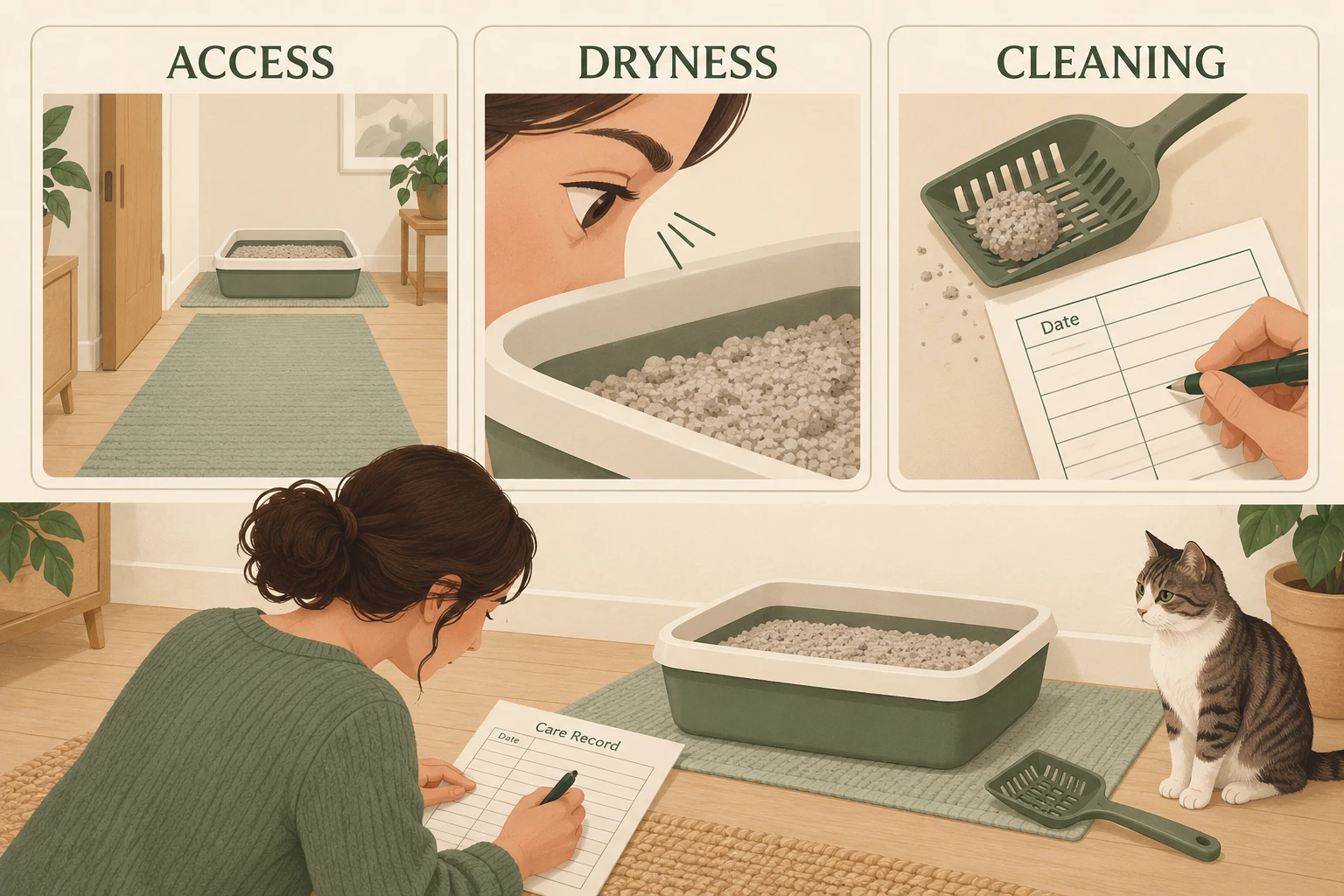
Use one dated record beside the household supplies. Write the tray location, last scoop, last full service, person responsible and the state of the indoor option. Keep the entry factual: “catio open,” “catio closed,” “tray dry,” “route blocked” or “service completed.” Avoid chemical or disinfection recipes; follow the product label for any ordinary cleaning item and ask an appropriate professional about a contaminated or unusual situation.
| Check | Write the answer |
|---|---|
| Access | Indoor tray remains available? Catio state and person checking: ___ |
| Dryness and condition | Tray and surrounding area observed dry and usable? Date and observer: ___ |
| Cleaning route | Approach, scoop, waste route and return location: ___ |
| Stop state | Weather, damage, closure or unknown condition: keep the cat indoors and resolve it before relying on this tray. |
Cats Protection advises removing deposits twice a day, or more often if needed; ASPCA advises scooping at least daily. Plan reliable access for those checks rather than postponing care until convenient. If the additional tray cannot stay accessible, dry and regularly cleaned, keep it out of use and maintain the familiar indoor option. A record helps the next person see what happened; it cannot prove use or suitability.
Fit it into the wider room plan
Use the catio interior layout guide to keep the cleaning route visible beside perches and resting places. The catio layout guide can help compare the access point with the household’s daily-care route. For indoor alternatives, see the small-space litter access guide, then record the chosen indoor location in the cat room planner. A calm retreat documented in the hideaway placement guide should remain available when a person is servicing the tray.
Copy this access and cleaning card
| Record | Your answer |
|---|---|
| Indoor baseline | Where is the familiar indoor tray, and who checks it? ___ |
| Additional tray | Location and purpose; extra choice rather than replacement: ___ |
| Open state | Who confirms access, dryness and a usable route? ___ |
| Closed state | What changes during weather or cleaning, and where does the cat toilet instead? ___ |
| Service route | How does a person scoop, remove waste and reset the area without forcing the cat? ___ |
| Stop and review | Which unknown keeps the cat indoors until resolved? ___ |
The plan is ready for observation when the indoor option is documented, both catio states have a named checker, the service route is practical and the household knows what unresolved weather or access means. Treat the arrangement as provisional and watch the cat’s voluntary use. A change in toileting, repeated avoidance or apparent discomfort belongs with a veterinary team, not with a new enclosure layout.
Sources and scope
- Cats Protection: Cats and Toileting — toileting context and behavior-change boundaries.
- Cats Protection: Our Guide to Indoor Cats — indoor resources and environment.
- ASPCA: Litter Box Problems — access, cleaning and veterinary escalation context.
The tables and service sequence are original editorial planning aids. Images are AI-generated illustrative concepts, not tested layouts, containment advice or safety certifications.