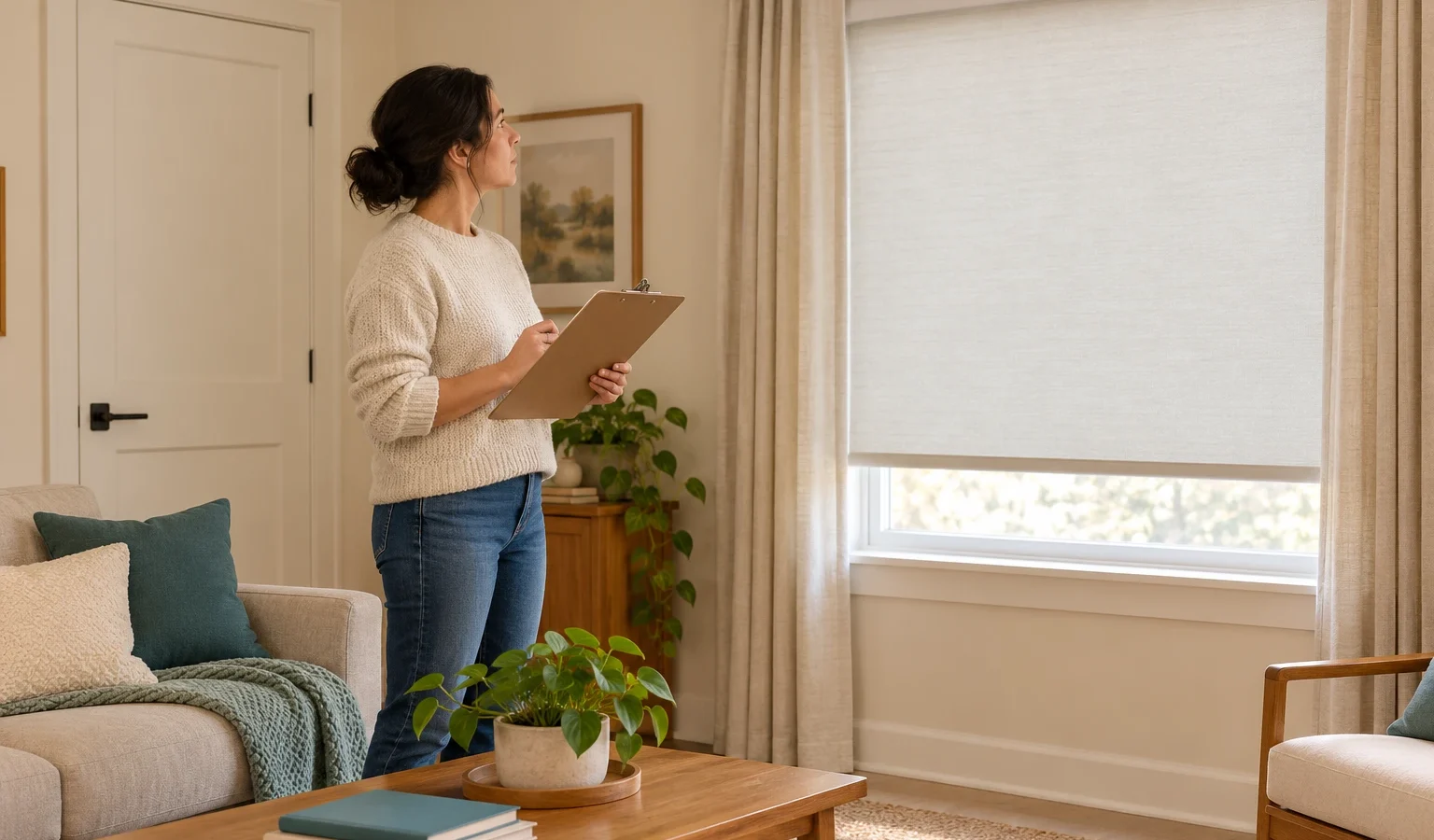
A renter can inherit blinds and curtains without inheriting a clear record of how their cords, loops and nearby furniture fit into the cat’s room. Start with an inventory. Which window treatment is in each room? Which part moves when a person opens, raises or draws it? Where can a cat climb, jump or pass while the treatment is being used? Write what you can observe, then separate the building question from the physical room question.
The BC SPCA Bark! guide says that cats can become tangled in the cord used to raise and lower window blinds, leading to serious injury. That source supports the narrow operating-blind-cord point. It does not establish a rule about every curtain tie-back, hardware type, cord height or installation method. The Cats Protection safety guide supplies broader household context about electric cables, entanglement hazards, window screening and securely closed windows and doors. The room record below is an editorial planning aid, not an engineering, veterinary or product certification.
Inventory one room at a time
Walk the apartment when the cat is elsewhere. Record the window, blind or curtain, the operating part a person touches, any loop or tie-back, and furniture or shelves that create a route toward the treatment. Do not pull, shorten, detach, drill or tape anything as part of this inspection. A renter’s first question is what the lease or property manager permits; the second is what the actual room presents. Permission to ask about a treatment does not prove that the treatment is suitable for the cat.
For each window, note whether the window closes and latches as expected, whether the cat can reach the treatment from its usual route, and whether a person can inspect the entire operating area without moving an unstable object. The window-perch checklist is useful for separating window condition from nearby resting furniture. It does not turn a blind or curtain into a perch component.
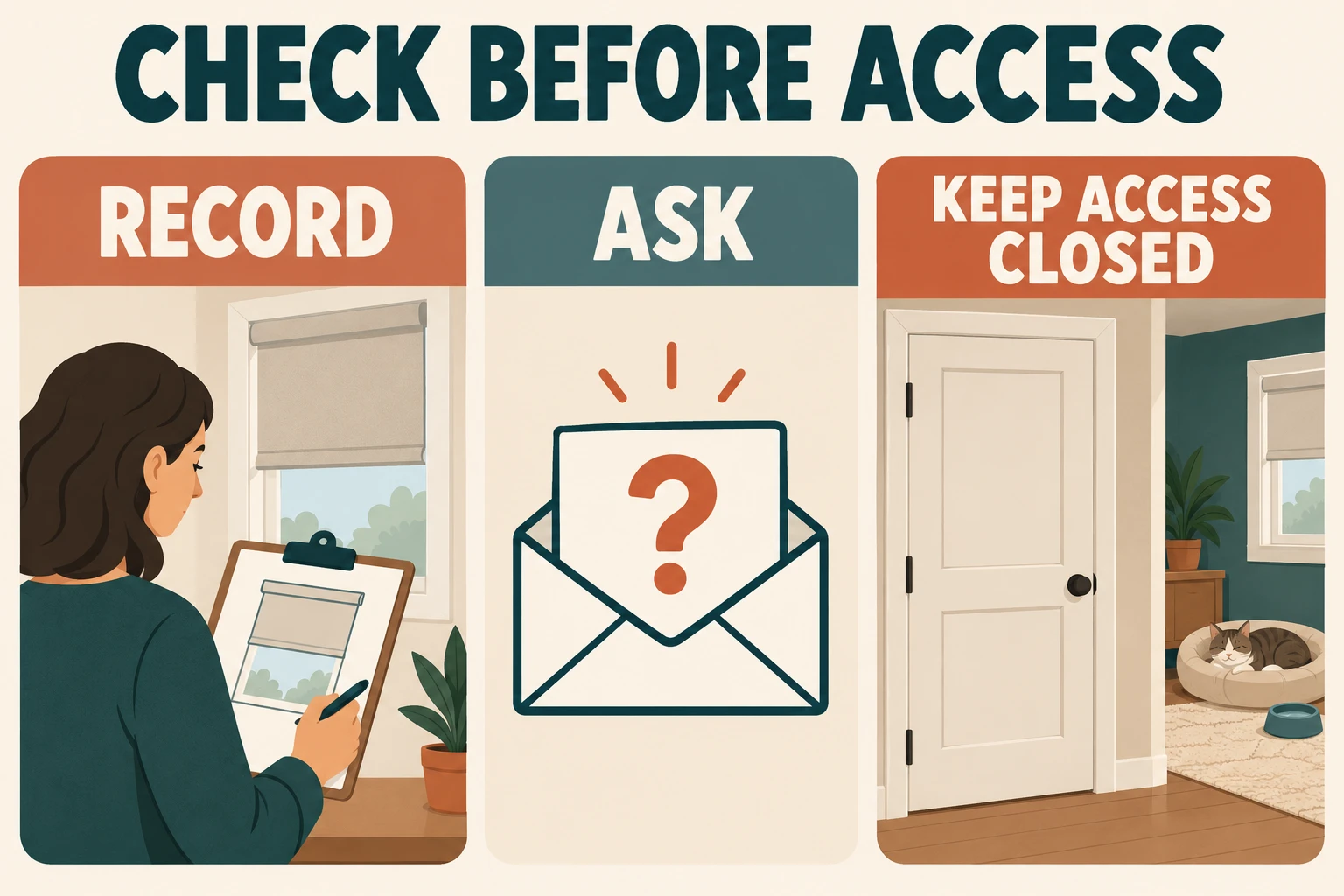
| Room state | Record, checked by and stop rule |
|---|---|
| Treatment inventory | Window and treatment: ___. Operating part, loop or tie-back observed: ___. Checked by: ___. Stop: Do not treat an unidentified part as resolved. |
| Renter permission | Lease or property contact and written answer: ___. Checked by: ___. Stop: Keep any proposed change out of the plan until permission is clear. |
| Physical room check | Window latch, route, nearby furniture and cat access observed: ___. Checked by: ___. Stop: Keep the cat away from the unresolved treatment and keep the window closed if its state is unknown. |
| Handoff | Who checks before ordinary curtain or blind use, and where is the record: ___. Checked by: ___. Stop: Do not hand the room to another person as resolved when an observation is missing. |
Keep permission and physical access separate
Write the property question in plain language: may the renter replace, remove, secure or otherwise alter this treatment? Record the contact, date and answer. Do not infer permission from a neighbour’s window, a product advertisement or the fact that the treatment was present when the lease began. The plan can remain useful without proposing a change: it can document what exists and identify who must answer an unresolved question.
Then record the physical question separately. Can the cat reach the operating blind cord from a normal climb route? Is a curtain tie-back or loop present, and where does it sit when the curtain is open? Is a cord hidden behind furniture, or does moving the furniture create a different route? These are observations and household questions, not universal safety ratings. If you cannot inspect the treatment or its route, mark it unresolved and keep the cat away rather than guessing.
The cat room planning guide can help map the window, furniture and ordinary routes. Use the hideaway placement guide to choose a calm closed room with ordinary resources while an unresolved treatment is being reviewed. Do not force the cat toward a different resting place or use a new barrier that has not been checked.
Write the ordinary-use handoff
A cord check can fail during ordinary life when someone opens the curtain for light, raises the blind to clean or moves a chair toward the window. Name the person who checks the room before that action and write where the cat will be while the treatment is handled. “Someone knows” is not a handoff. The record should say what is observed, who checked it and what happens when an item is missing from the record.

- Locate the cat before opening, raising or drawing the treatment.
- Keep the cat in a separate calm room with its ordinary resources while an unresolved treatment is inspected or used.
- Record the observed operating part, nearby route and window state.
- Stop if the record, permission or physical access question is incomplete; do not force the cat to move or improvise a hardware fix.
- Return the room to its written state and tell the next household member what remains unresolved.
If a window will be opened, treat window security as a separate check. The ASPCA guidance recommends snug, sturdy screens and warns that childproof window guards do not protect cats. That source does not certify a window treatment, and a screen recommendation does not answer the cord or curtain inventory. Keep the window closed when its security is unresolved.
Review after a move or room change
Recheck the room after moving a sofa, adding a shelf, changing a curtain, replacing a blind or changing the cat’s usual route. A treatment that was out of reach from one layout may be reachable from another. Record the date and the changed observation, then repeat the permission question if the proposed response would alter the rental. The balcony before-access plan shows how to keep property permission and physical review in separate records; the same discipline helps here. If the treatment is near laundry equipment, use the laundry access checklist to document the room boundary and handoff.
There is no universal cord height, tie-back position or product category that resolves every apartment. A useful stop state is specific: the cat remains in the calm room with its ordinary resources, the window stays closed when its state is unknown, the unresolved person is named, and the next review is written down. That gives the household a next action without pretending that an observation is a certification.
For a room that also has blind or curtain cords, keep that window-cord review separate from the phone and laptop charger put-away plan and record both owners.
Sources and scope
- BC SPCA Bark! — Window blinds, printed page 7: operating blind-cord entanglement point only.
- Cats Protection: Keeping Your Cat Safe in the Home: general household access context.
- Cats Protection: Keeping your cat safe: cables, entanglement, screens and closed-window context.
- ASPCA: High-Rise Syndrome: screen and window-guard boundaries.
The room inventory, permission split, handoff fields and unresolved stop states are original editorial planning aids. Images are AI-generated illustrative concepts, not tested arrangements, installation instructions, veterinary assessments or safety certifications.