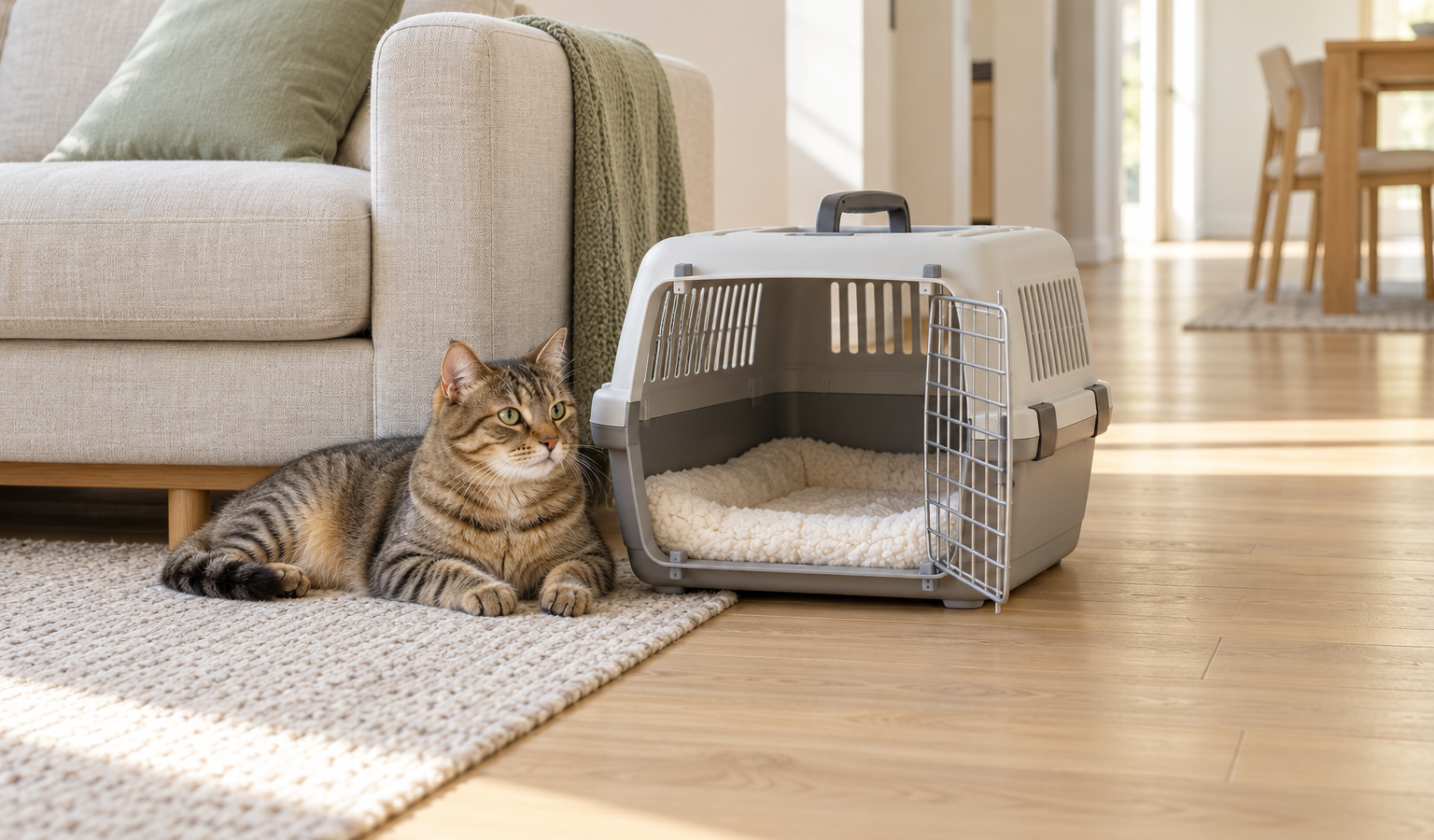
A cat carrier stored at the back of a cupboard is easy to forget until a trip is due. In a small apartment, leaving it out takes planning: the shell may fit beside the sofa, but its door might block the walkway or its handle might sit beneath a table rail.
Start with a quiet, accessible floor-level spot in a room your cat already uses, then check the carrier with its door open and with the route out of the room clear. The Feline Veterinary Medical Association carrier infographic recommends leaving the carrier out at home and using familiar bedding. That gives a reason to plan an everyday place; it does not mean every unused furniture gap will work.
This is an editorial space-planning checklist, not a carrier safety certification or a treatment plan for travel anxiety. Follow your carrier’s instructions for assembly, ventilation, door removal and transport. The illustrations are AI-generated concepts.
Choose a location before choosing a disguise
Compare two or three possible spots with the actual assembled carrier. Do not buy a smaller carrier simply to suit a gap: suitability for your cat comes first. Use our small cat room planning guide to keep this resting option from consuming the apartment’s main walking route.
| Possible location | Why it may work | Check before using it |
|---|---|---|
| On the floor beside a fixed sofa | Within an everyday living area and easy to see | The open gate must not cross the walking route. Upholstery and throws must not cover the vents. |
| At the edge of a quiet bedroom | May offer a less busy place to approach | Check the bedroom door, wardrobe doors and your nighttime route around the bed. |
| Under an open, fixed side table | Can share floor space with existing furniture | Check the top handle, any removable lid, side vents and a straight route to lift or pull the empty carrier out. |
| Inside a closed cupboard or tight decorative cabinet | Conceals storage | It does not provide open everyday access. Do not treat a closed storage location as the cat’s accessible resting place. |
| Beside a reclining or folding mechanism | May look like unused space when furniture is still | Reject a position where moving parts, a door or furniture can strike or trap the carrier or cat. |
A location is only a candidate until you have checked it in normal use. Open the nearby doors and move any furniture that is normally moved there, with the cat away from the test area.
Measure three different spaces
The outside dimensions on a product listing describe the carrier, not the space needed to use it. Separate the footprint from the moving door and the removal route. There is no universal clearance number in this checklist: carrier designs and room arrangements differ.
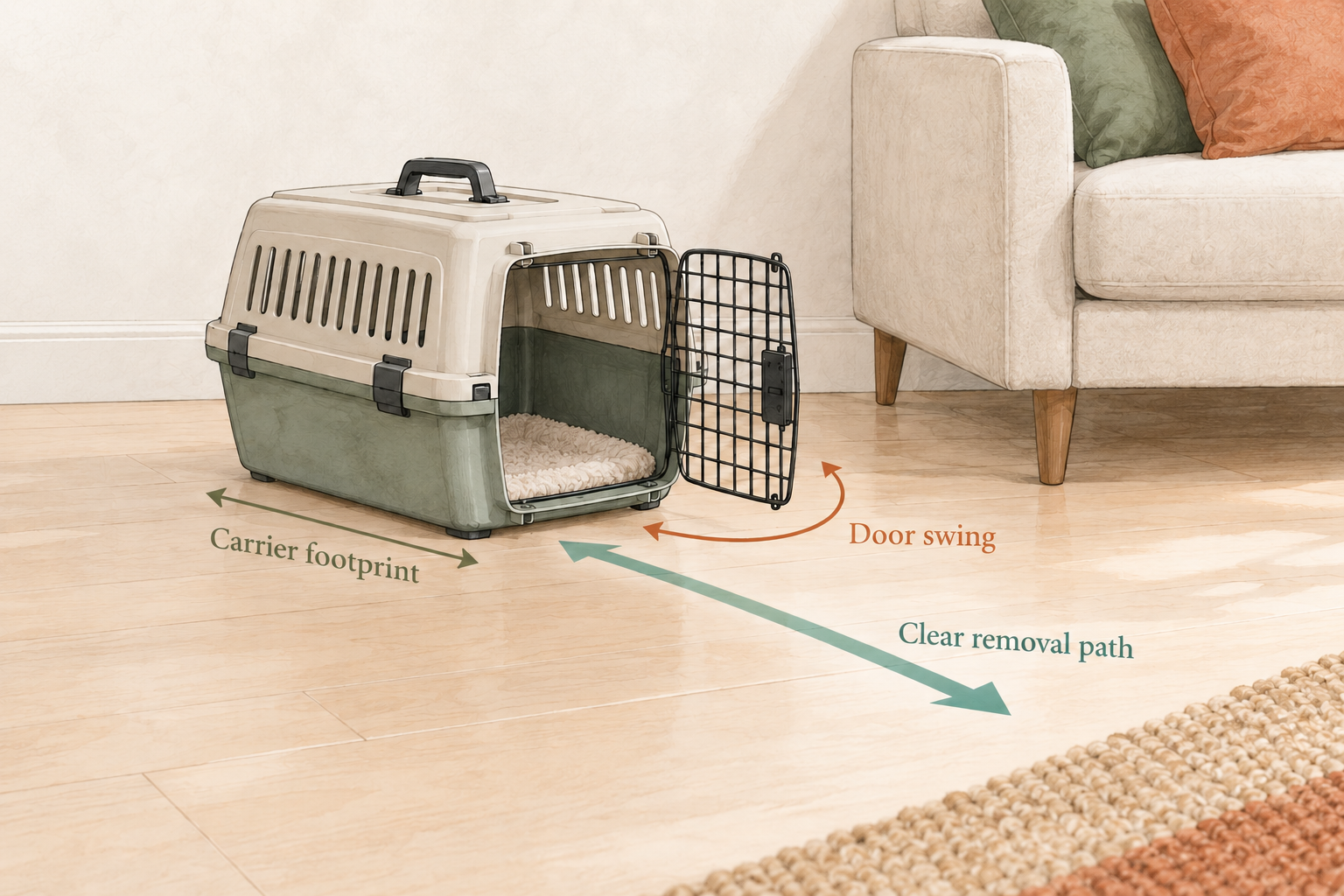
- Body space: measure the assembled carrier’s widest and longest points, including protruding catches. Check the top handle and any top-opening section. Compare these with the narrowest part of the proposed location.
- Door space: open the gate through its intended movement. Check whether it hits a table leg, hangs into a walkway or obstructs the entrance. Only remove or secure a door as the manufacturer permits; do not improvise a fastening.
- Removal space: with the carrier empty, check that you can reach it, secure the door and take it out without dismantling furniture. A handle you can see is not necessarily one you can comfortably reach.
A fill-in fit and access worksheet
Copy this table into a note and fill it in for each candidate location. A failed check means reconsidering the spot, not squeezing the carrier into it.
| Check | Your observation | Reconsider the spot if… |
|---|---|---|
| Assembled footprint | Carrier width × length: ___; available area: ___ | The body or catches press against furniture. |
| Gate movement | Open gate reaches: ___ | The gate cannot open normally or becomes a trip obstacle. |
| Ventilation openings | Nearby fabric, wall or stored items: ___ | Something covers the openings or conflicts with the manufacturer’s clearance guidance. |
| Top access | Handle/lid can be reached: yes / no | You must tilt or partly dismantle the carrier to access it. |
| Retrieval route | Route to the room door: ___ | You need to move heavy furniture or navigate a blocked exit. |
| Daily traffic | Nearby doors and walking routes: ___ | The arrangement obstructs people or moving furniture. |
Try the removal route with an empty carrier
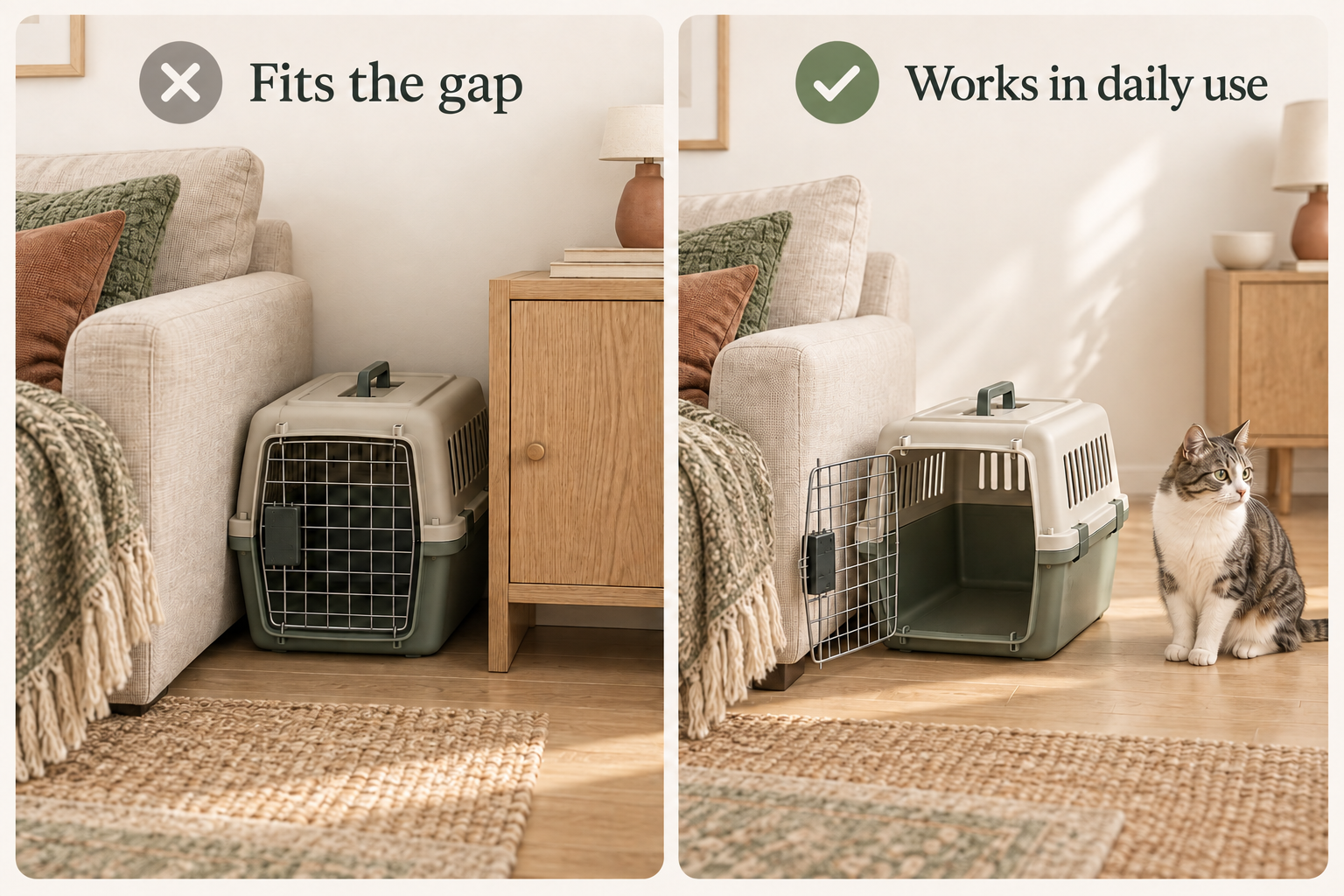
Before encouraging your cat to use the new spot, perform a simple layout rehearsal with the carrier empty. Reach the handle and door, remove it from its position and carry it through the room doorway. Put it back and check that the open gate still leaves the ordinary walking route usable.
This test only checks your arrangement. It does not establish how the carrier performs with a cat inside or replace the manufacturer’s handling instructions. If the route is awkward while empty, choose another location rather than testing the problem with your cat inside.
Make it available without forcing the choice
Add familiar bedding if suitable for the carrier and your cat, and leave access available. The AAFP/ISFM environmental needs guidelines emphasize a safe place within a cat’s environment. Treat the carrier as an additional option, alongside other resting places, rather than the only place the cat is allowed to settle.
Keep this layout separate from any training plan. Do not force your cat inside to prove the spot works. If your cat is distressed by the carrier or you need advice for an upcoming veterinary visit, ask your veterinary team about a suitable approach. A better furniture arrangement does not guarantee relaxed travel.
For the rest of the room, our cat room planning guide covers the broader layout. If the carrier is part of a newly adopted cat’s first room, use the small-apartment transition-room guide for that different setup.
Recheck after rearranging furniture and before travel
- Remove items that have accumulated beside or above the carrier.
- Inspect its door, catches and other parts using the manufacturer’s instructions.
- If a removable gate was stored separately, locate it and reassemble the carrier correctly before transport.
- Repeat the empty-carrier route check after moving furniture.
- Check that bedding and nearby fabric do not obstruct ventilation.
The useful everyday spot is the one that remains accessible when life gets busy. Keep the entrance usable, leave the vents unobstructed and preserve a practical route out.
For an upcoming sitter visit, include the carrier location in the apartment handoff worksheet, alongside supply locations and the agreed room-access rules.
When the emergency map depends on a carrier that must remain accessible, add the cat emergency kit storage map beside the carrier’s fit and access check.
Before loading starts, pair the carrier’s empty-removal check with the studio moving-day arrangement so the carrier location and care handoff are recorded separately.
Sources and further reading
- Feline Veterinary Medical Association: Cat Carrier Infographic — carrier features and making it familiar at home.
- AAFP/ISFM Feline Environmental Needs Guidelines — environmental needs and safe resting places.