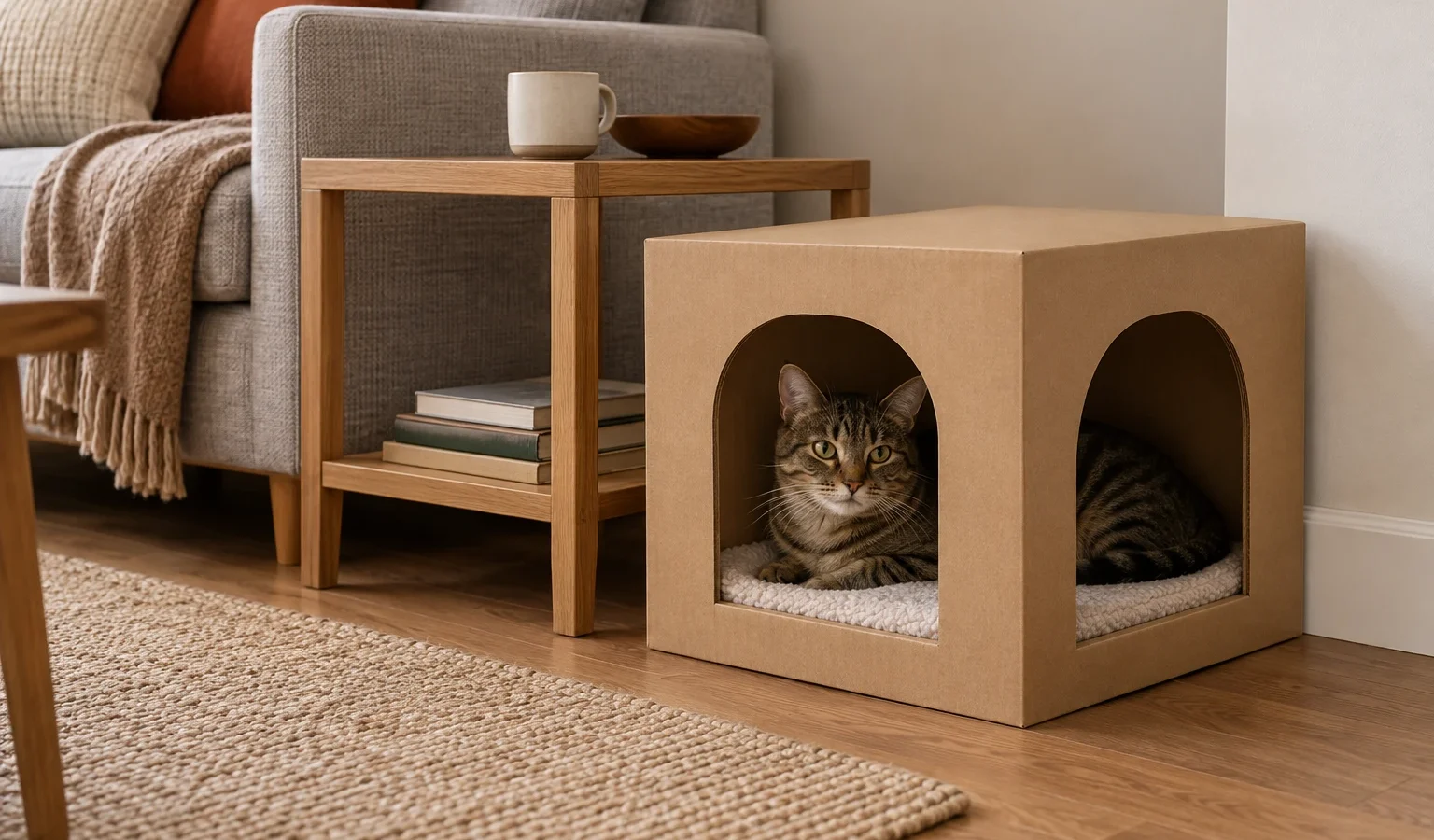
A cat hideaway can fit beside a sofa, under a stationary table or in a spare corner. The useful question is whether that location still works when the room is busy and the hide needs cleaning. Start with the location your cat already chooses, then compare the space around it before buying another bed.
This guide is for an everyday retreat that a cat can enter and leave voluntarily. It is a planning aid, not veterinary advice or a construction specification. For a newly arrived cat, start with the separate transition-room guide; for emergency transport access, use our carrier storage guide.
What makes a retreat different from an unused gap?
A useful retreat offers concealment without making the cat hard to reach in an emergency. FelineVMA’s environmental-needs guidance recommends a private safe place, entry and exit from at least two sides when threatened, and separate safe places for individual cats. It also notes that many cats prefer raised locations. Height is an option to consider, not a reason to improvise an unsupported shelf.
For this floor-space guide, compare accessible floor-level candidates first. If your cat already uses a suitable elevated retreat, keep that preference in the plan. For any raised product, follow its installation and weight instructions; this article does not establish safe loads or jump distances.
Compare the location, not just the bed
Use the table below as an editorial planning worksheet. These are conditional examples rather than approved designs. A furniture type alone cannot establish that a location is suitable.
| Candidate | What to inspect | Reject or change the location if… |
|---|---|---|
| Beside a stationary open side table | Each hide opening faces open floor; the table stays in place during ordinary use. | A chair, bag or table leg regularly occupies an approach. |
| Under a fixed, open-legged table | The hide and both approaches fit without being pushed against surrounding furniture. | People need to put their feet there, or the table moves when used. |
| A quiet bedroom corner | Normal door movement and laundry storage leave access available. | A door can close the route, or clothes accumulate over an opening. |
| Under a bed | You can inspect the whole space and remove loose items while it is empty. | The area contains inaccessible debris, cables or moving storage parts. |
| Behind a reclining sofa or appliance | Look for mechanisms, heat and difficult access. | Moving parts or inaccessible equipment share the gap. Choose a different retreat. |
Keep the resting area separate from food, water and litter resources. Do not compress every cat resource into the hide’s footprint to make a tidy-looking corner. Our room-planning overview can help map the other resources around it.
The two-route check
Two visible openings are a starting point. Check where each one actually leads. An opening facing a wall, a stored suitcase or the same narrow furniture gap does not provide a useful separate approach.
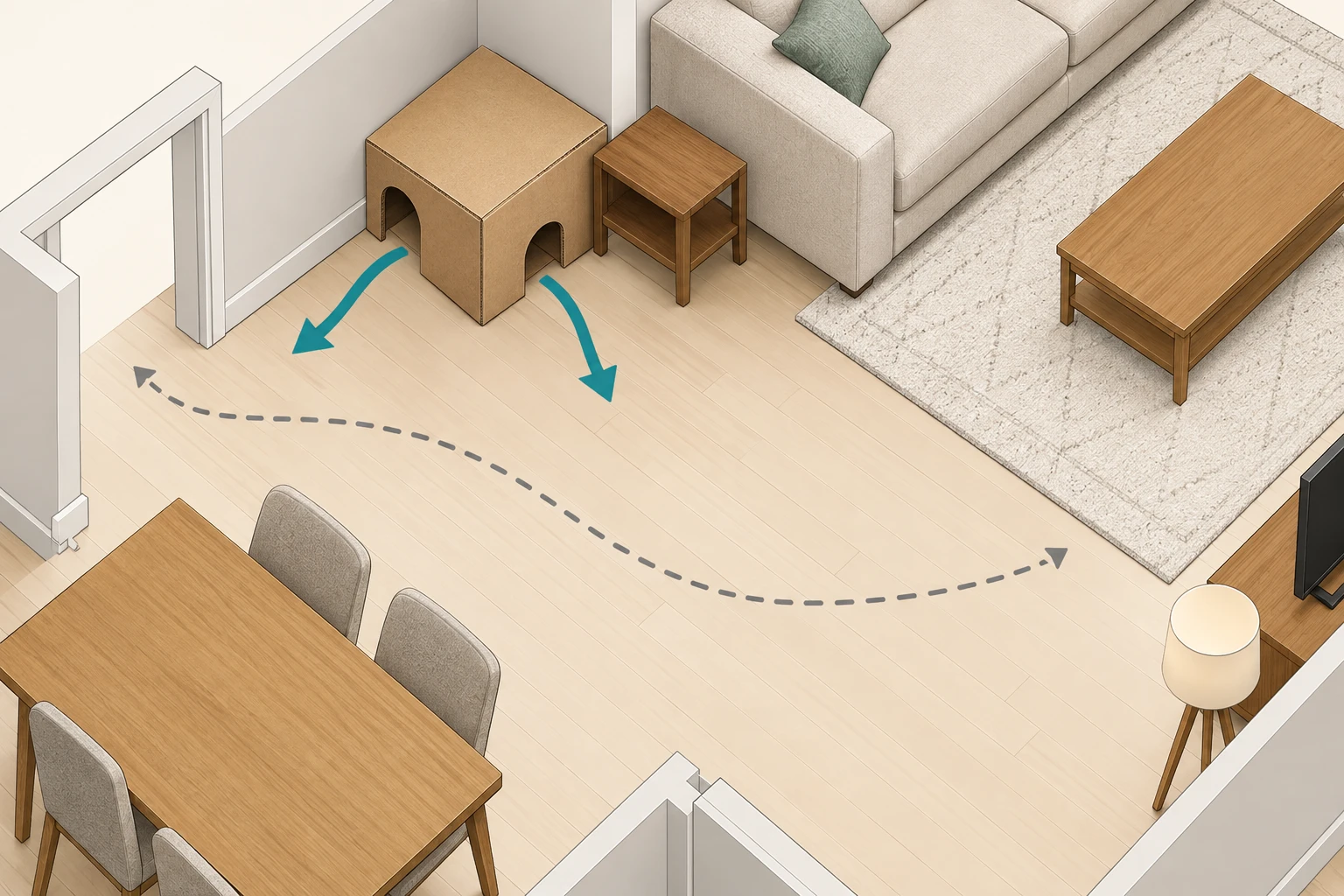
- Inspect the empty hide. Check its openings and interior for loose fastening material, damaged edges or anything likely to snag. Follow the product’s instructions if it is a purchased hide.
- Trace each approach. Follow the open floor from each doorway into the room. Note obstacles separately, even if both openings appear generous in a photograph.
- Put nearby furniture in its usual positions. Check the normal chair position, open door and place where bags are dropped. Change the location if ordinary use blocks a route.
- Check the return journey. Make sure the household’s storage routine will not gradually fill either approach. Write down what must stay out of that space.
Do this inspection while the hide is empty. Do not push a cat through it to test the route. There is no universal clearance number here: the animal, hide and room differ, and a tape measure alone cannot prove suitability.
Choose a hide you can maintain
Before installing the retreat, work through its empty-space cleaning sequence: remove the pad, inspect the interior, access the floor behind it and put everything back without blocking either opening. A washable pad is only useful if you can remove it easily. Follow care instructions for the materials; replace a damaged hide rather than covering damage with loose tape.
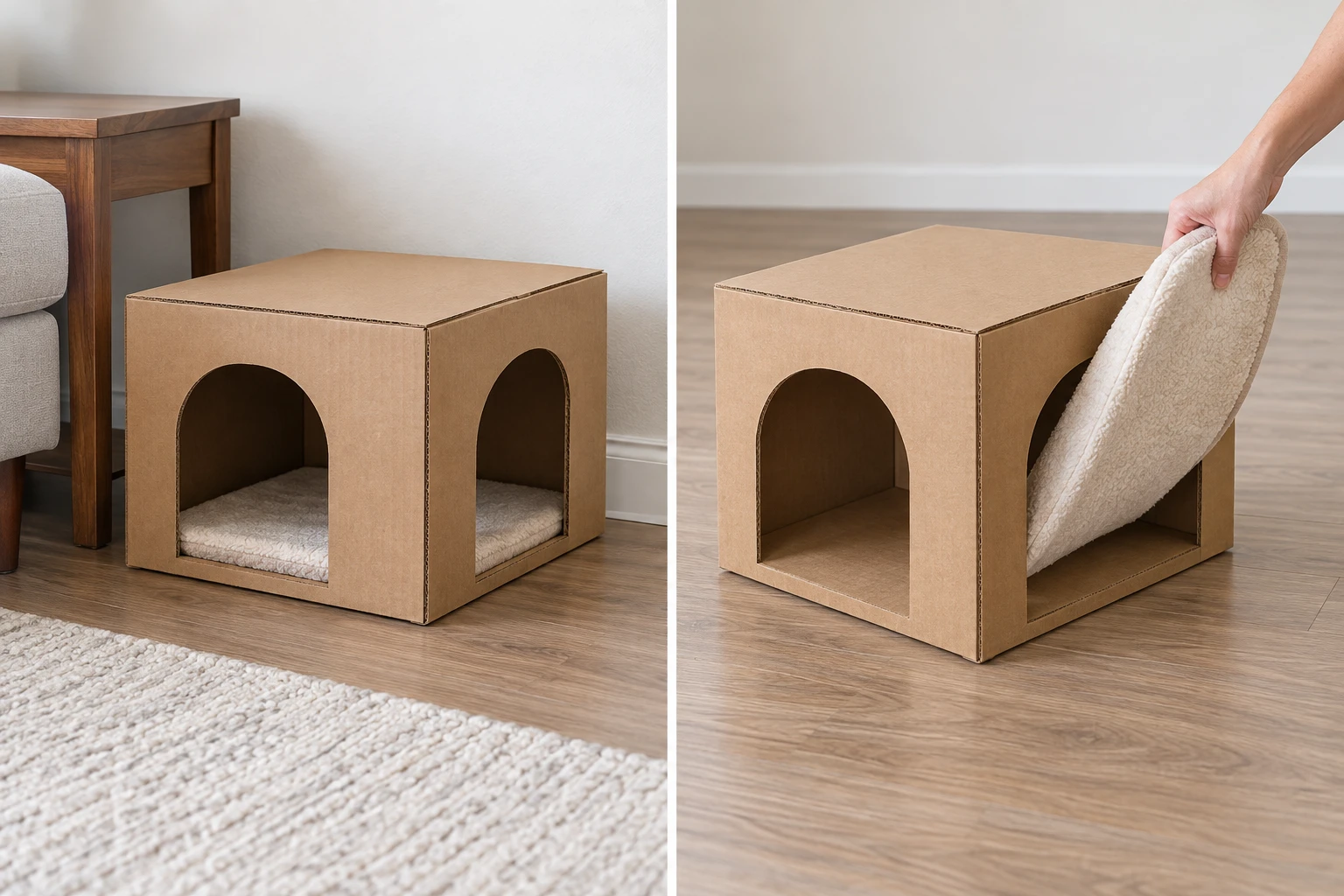
A practical distinction: an accessible cleaning route is a household task, not permission to pull a resting cat out. Wait until the cat leaves voluntarily for ordinary maintenance. If access is urgently needed for the cat’s welfare, seek appropriate veterinary guidance rather than treating a no-disturb rule as absolute.
A short household agreement
Cats Protection’s hiding guide advises providing a quiet hiding place and allowing the cat to come out without pressure. Turn that into a simple household rule: nobody reaches into the retreat for play, photographs or routine attention, and visitors are told where it is.
In a multi-cat home, offer individual retreats in different locations. Do not count two boxes side by side as two independent locations if one cat can control the shared approach. Watch how the spaces are used; the layout is a candidate arrangement, not a guarantee that cats will share it comfortably.
Copy this placement card
| Record | Your answer |
|---|---|
| Current preferred retreat | Where does the cat already choose to rest? |
| Candidate location | Room and furniture beside the hide |
| Opening A / opening B | Where does each route lead? What can block it? |
| Normal household use | Door, chair, bag and laundry positions to check |
| Maintenance | How will you remove the pad and inspect behind the empty hide? |
| Household rule | Who needs to know not to disturb the retreat? |
| Observation | Voluntary use, avoidance or obstruction; no forced trial |
Use the free room planner for the wider layout, then add this card to check the hiding area in detail. For a room that serves several purposes, see our shared-room planning guide.
If the cat ignores the new hide
Do not remove an existing suitable retreat simply to make the new purchase the only option. Check access and placement, then allow voluntary exploration. Sudden or increased hiding can be associated with stress or illness; Cats Protection recommends a veterinary check for a change from usual behavior. A new bed is not a diagnosis or a substitute for care.
Before decorating for visitors, use the Halloween doors, decor and candy setup to confirm the quiet room, door roles and final reset route.
Before a cleaning session, use the room-by-room vacuuming plan to keep a refuge available without bringing the running machine toward a hidden cat.
If the washed bed is part of a retreat, the small-apartment bedding wash and return plan helps you preserve an ordinary rest option while the removable parts are being handled.
If the bed also serves as a retreat, pair the hideaway placement guide with the winter day-and-night bed placement check so access and the cat’s familiar choice remain visible.
Sources and further reading
- FelineVMA and iCatCare: Your Cat’s Environmental Needs — safe places, separate resources and individual choice.
- Cats Protection: Cats Hiding — undisturbed retreats and when a behavior change needs veterinary attention.
The comparison table and placement card are original editorial planning aids. Images are AI-generated illustrative concepts. We have not tested the pictured setup or assessed it for an individual animal.