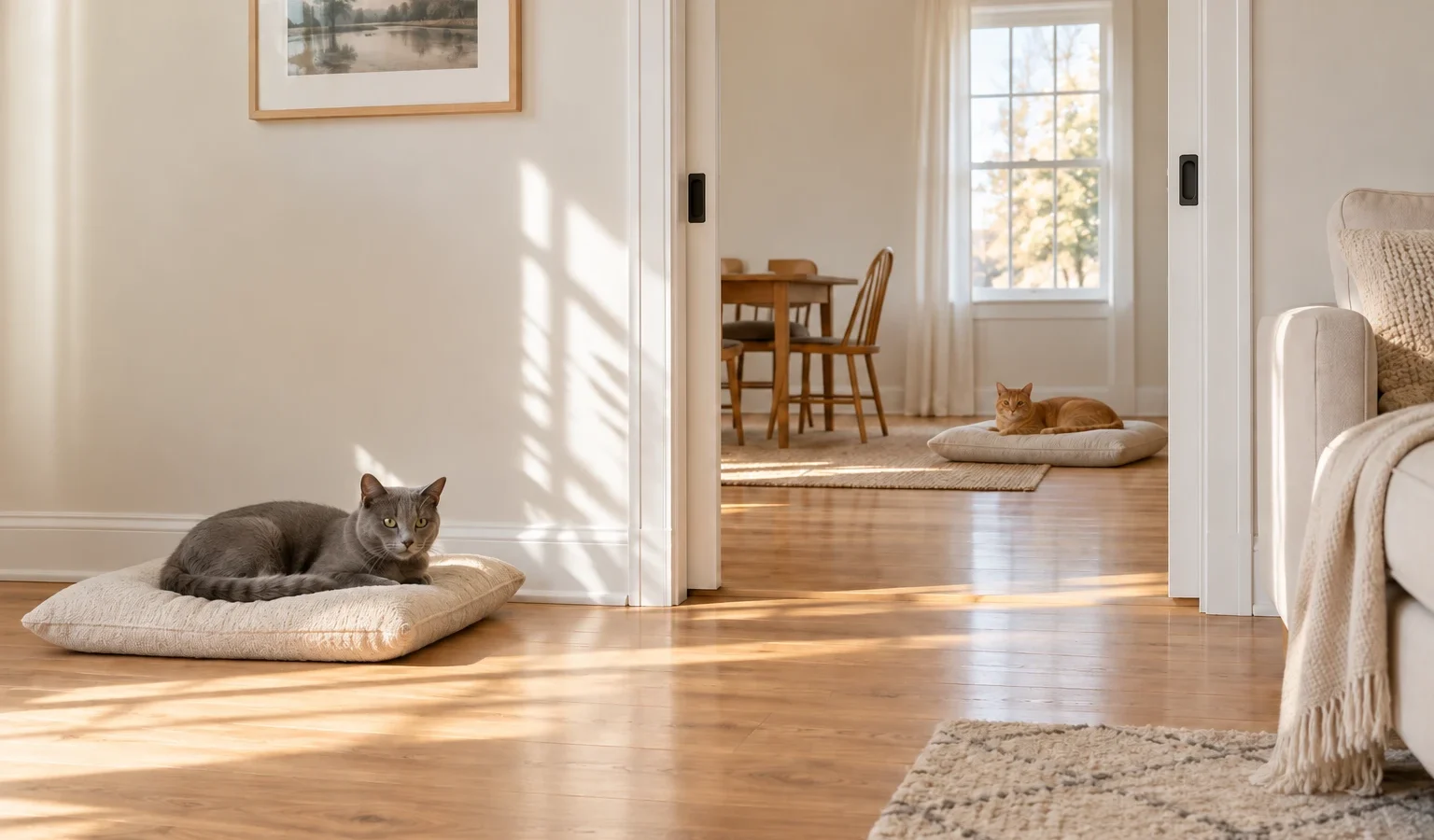
Planning for two cats in a small apartment takes more than an inventory of bowls and beds. A resource can be present while a particular cat rarely reaches it, or a normal change in the room can close its route. Start with a sketch of the current home and record each cat separately.
This resource access map is for an established household. It helps you identify questions about the layout; it cannot certify that an apartment suits two cats or diagnose their relationship. If a new cat is arriving, use our transition-room guide for that separate planning stage.
Give locations names before counting objects
On paper, mark existing food, water, litter, scratching, resting and play locations. Use simple names such as Water A or Bedroom Rest. Write the number of items beside each location without confusing the two counts. Add doors and ordinary furniture; exact measurements help your own drawing, but this article sets no universal clearance.
The FelineVMA’s environmental guidance calls for separated key resources and individual access. Its general litter-box starting point is one per cat plus one: three for two cats. That count does not establish whether the arrangement works for your household. Record locations and access as well, and discuss individual needs with your veterinarian.
Illustrative example: three boxes in one bathroom are three items at one location. Closing that room’s door removes access to all three. Putting items elsewhere would change the map, but a different location must also be suitable and usable; merely scattering furniture is not a solution. This is a planning example, not a tested home or advice to abruptly move familiar boxes.
Draw a route from each cat’s familiar resting place
Choose places your cats already use voluntarily. Draw a possible route from each resting place to each resource location, then mark what you have actually seen. An imagined route is a question to check, not proof of access. Include turns, doorways and places where furniture narrows the route.
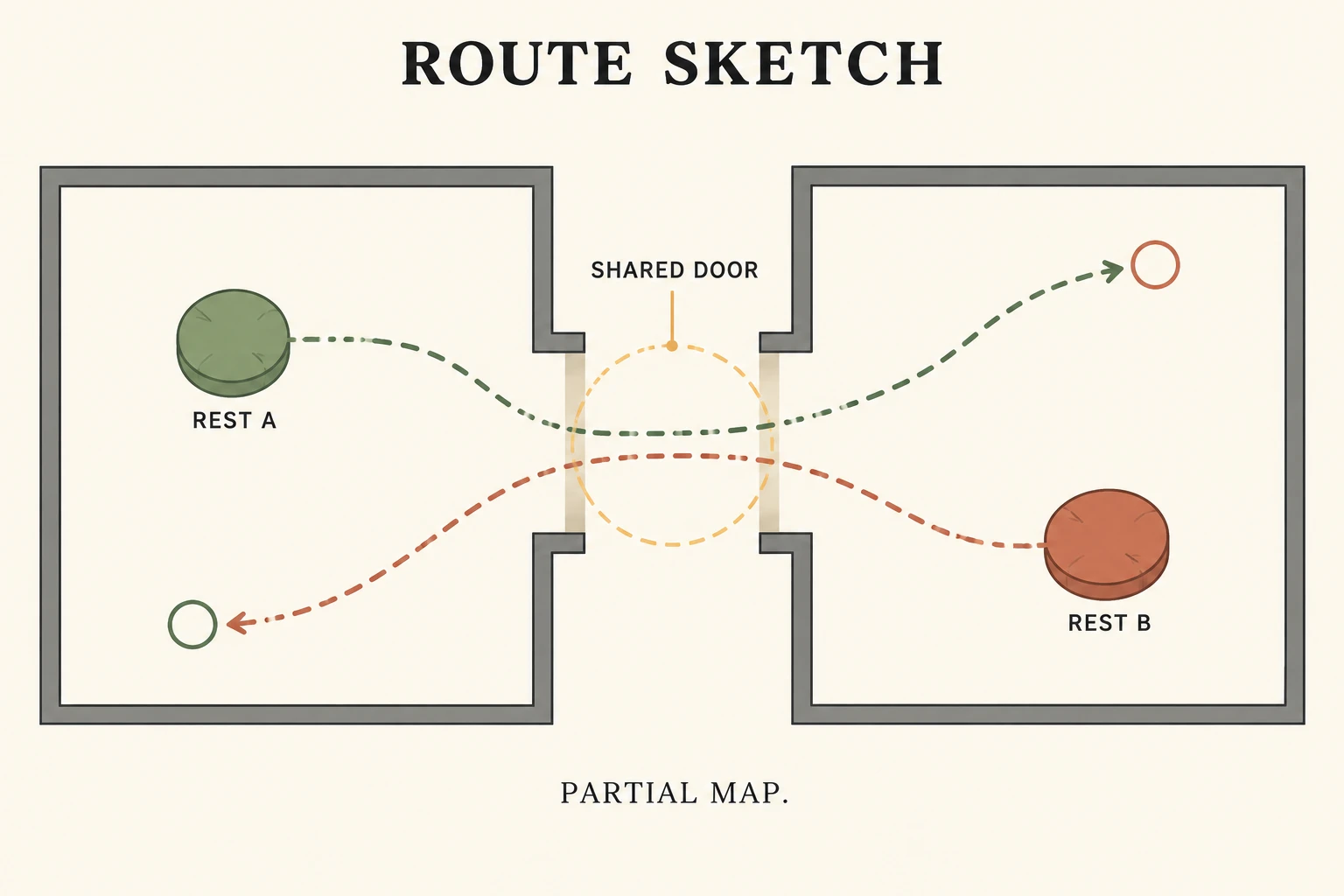
Look for several resources that all depend on the same doorway. Also note whether approaching a place leaves an obvious way out. FelineVMA describes safe retreats with more than one entry or exit where another cat could impede access. A sketch cannot establish that a specific bed or furniture arrangement meets that need.
Use the hideaway placement guide when considering a retreat. Elevated options require their own support and access checks; this plan does not prescribe mounting hardware or assume every cat can climb. Preserve choices that suit each cat’s mobility.
Record observations without staging a confrontation
Watch ordinary household use from a distance. Do not place a cat beside the other cat, lure them into a narrow route or close a door to see what happens. Keep essential resources accessible throughout. The record should describe what you saw, including choosing another location.
The FelineVMA’s intercat-tension guidance explains that blocking can be subtle, including lingering in a doorway or prolonged staring. It also cautions against interpreting relationships as a fixed dominance hierarchy. Describe the action rather than assigning a cat a “boss” or “submissive” label.
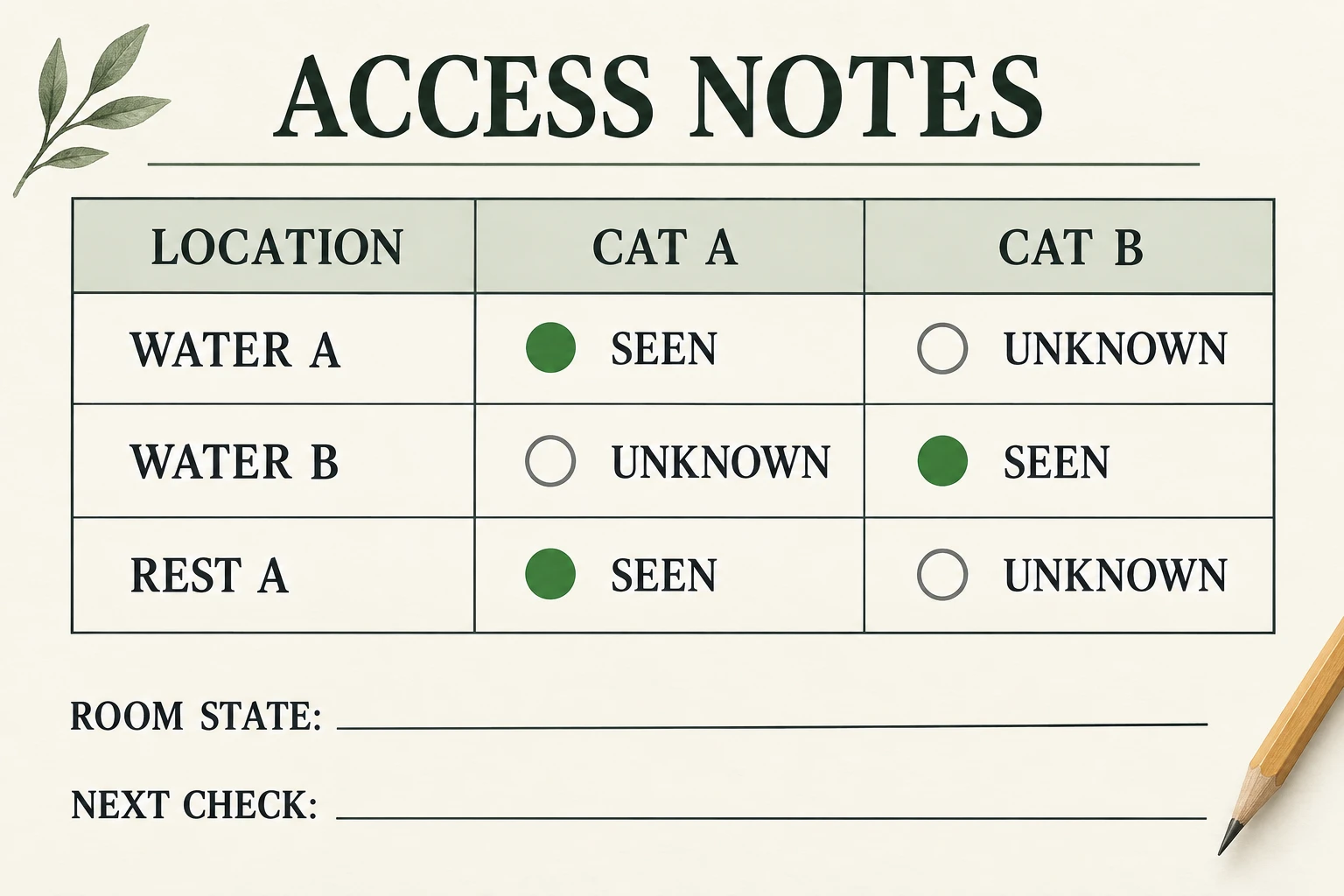
| Record | Example wording |
|---|---|
| Location and room state | Water A; bedroom door open; evening use |
| Cat A’s observed use | Approached, drank and left while Cat B rested elsewhere |
| Cat B’s observed use | Not observed; access remains unknown |
| Specific question | Does ordinary door use affect this route? |
| Next check | Review the existing evening arrangement without restricting either cat |
“Not observed” is different from “cannot reach.” A single successful visit also does not prove reliable access across the day. Avoid scoring a cat’s health or relationship from the table. This is a household observation aid, with no prescribed observation duration or success percentage.
Check the room as you normally use it
A useful map includes everyday room states: working, cleaning or using a room in the evening. Note doors that routinely shut, a chair pulled into the hallway or a bag set beside a resting place. Do the physical furniture check with cats elsewhere; never create resource deprivation as a test.
Worked decision: the drawing shows Water A beyond a bedroom door and Water B in the living room. Cat A has been seen using both; Cat B has only been seen using Water A. If the bedroom normally shuts during calls, the note is “Cat B’s use of the remaining location is unknown,” not “two water bowls are enough.” Keep appropriate access available and resolve the specific unknown before relying on that arrangement.
Our cat room planner can help draw the surrounding space. Its plan and checklist complement this per-cat record; neither determines compatibility or replaces veterinary assessment.
Choose one layout question to resolve
Start with a documented issue, such as a normally closed door affecting a familiar resource, rather than buying a complete furniture set. Consider a suitable additional option or revise the household arrangement while preserving needed resources and familiar choices. Change one candidate arrangement at a time so that the record remains understandable.
Food-station placement has additional daily-use considerations; use the feeding-station layout plan for that task. For litter locations, the small-space litter layout guide examines physical access and cleaning. Do not consolidate litter locations solely to make the sketch look tidy.
If there is repeated conflict, persistent avoidance or a change in eating, toileting or movement, seek veterinary advice rather than continuing a furniture trial. FelineVMA recommends checking medical causes and getting help with persistent tension. More space, different arrangements or professional support may be needed; this worksheet cannot promise peaceful coexistence.
Copy this compact access record
Use one entry per resource location and repeat it for ordinary room states that matter:
- Location name and resource: ______
- Items at this location: ______
- Normal room state: ______
- Cat A: observed approach, use and departure, or unknown: ______
- Cat B: observed approach, use and departure, or unknown: ______
- Shared doorway or other route question: ______
- One next check, while maintaining needed access: ______
The outcome can be a confirmed household observation, an unresolved question or a decision to seek help. It does not have to be a purchase. Keep item counts, location counts and each cat’s observed access separate when you revisit the map.
Sources and editorial scope
- FelineVMA / Cat Friendly Homes: environmental needs, separated resources and retreats
- FelineVMA / Cat Friendly Homes: intercat tension, subtle blocking and veterinary support
The location naming, per-cat worksheet and worked decisions are original editorial planning aids. Images and household examples are illustrative. We have not observed the pictured cats, tested the layout or established a behavior outcome.